Sleep Supplements and Medications: Interactions, Risks, and What to Check
Medical disclaimer: This article is for general educational purposes only and is not a substitute for medical advice. Supplement–medication interactions depend on the exact products, amounts, timing, health conditions, and individual circumstances. Do not stop, replace, reduce, or change prescription medication based on a supplement article. If you regularly take medication and are considering a sleep supplement, review the exact products with a pharmacist or other qualified healthcare professional.
Editorial scope:
This is an educational, evidence-informed article. It does not represent personal product testing or an individualized clinical assessment.
Sleep supplements are often purchased without a prescription, which can make them feel separate from medication decisions.
But once a supplement is taken alongside a prescription or over-the-counter medicine, the combination matters.
Melatonin, magnesium, valerian, chamomile, L-theanine, and multi-ingredient sleep formulas can differ in how they affect alertness, absorption, bleeding-related pathways, drug metabolism, and other physiological processes.
The safest question is therefore not simply “Is this supplement natural?” It is: “What exactly is in it, and how might those ingredients interact with what I already take?”
In this guide
Why Supplement–Medication Interactions Matter
An interaction does not always mean that two substances can never be used together. It means that one substance may change the effect, absorption, metabolism, or safety profile of another.
Depending on the combination, concerns can include:
- Additional sedation or reduced alertness.
- Dizziness or impaired coordination.
- Changes in medication absorption.
- Effects related to bleeding risk.
- Changes in how a medication is metabolized.
- Greater uncertainty when several supplements and medications are taken together.
For a broader overview of supplement safety, see our sleep supplement safety, risks, and interactions guide.
Sedating Medications Deserve Extra Caution
One of the clearest concerns is combining a sleep supplement with medication that already causes drowsiness.
Depending on the medication and supplement involved, the combination may increase sleepiness, dizziness, impaired coordination, or next-day impairment.
This can be especially important before driving, operating equipment, working at heights, or performing other activities that require alertness.
Do not assume that a supplement is harmless in this situation simply because it is sold over the counter.
Melatonin and Medications
Melatonin is widely available, but that does not make it interaction-free.
Because melatonin can affect sleepiness and alertness, combining it with sedating medicines may increase drowsiness in some adults.
Interaction concerns can also extend beyond sedation, which is why the exact medication list matters more than simply knowing that a product contains melatonin.
The timing of melatonin can also matter depending on the reason it is being used. Our sleep supplement timing and onset guide covers that separate question.
Magnesium Can Affect Medication Absorption
Magnesium is often marketed for sleep, but its interaction profile is different from that of sedating herbs.
One important issue is that supplemental magnesium can interfere with the absorption of certain medications when taken too close together.
That means the interaction question may sometimes involve timing rather than simply whether magnesium and a medication can ever be used by the same person.
A pharmacist can help determine whether spacing is needed for a particular medication.
Valerian and Other Sedating Substances
Valerian is associated with sedating effects and therefore deserves extra caution when combined with other substances that reduce alertness.
This can include prescription sedatives, other sleep products, and alcohol.
Because herbal products can differ in preparation and concentration, the label of the specific valerian product matters.
Chamomile Is Not Automatically Interaction-Free
Chamomile is often perceived as mild because it is commonly consumed as tea.
But herbal ingredients can still interact with medication or trigger allergic reactions in susceptible individuals.
The fact that an ingredient is familiar or traditionally used does not establish that it is compatible with every medication.
L-Theanine and Other Newer Sleep-Formula Ingredients
L-theanine is increasingly included in relaxation and sleep products, often alongside melatonin, magnesium, GABA, or herbal ingredients.
Interaction data for some newer or less extensively studied supplement combinations may be limited.
Limited evidence about an interaction should not be interpreted as proof that no interaction exists.
Multi-Ingredient Sleep Formulas Make Interaction Checking Harder
A product containing one clearly disclosed ingredient is usually easier to evaluate than a formula containing many active substances.
With a multi-ingredient product, check:
- Every active ingredient.
- The amount of each ingredient when disclosed.
- Whether the formula uses a proprietary blend.
- Whether another supplement contains the same ingredient.
- Whether several ingredients can contribute to sedation.
- Whether the complete formula has been evaluated with your medication list.
Our guide to combining sleep supplements explains ingredient overlap and multi-product risk in more detail.
Alcohol Can Further Increase Interaction Risk
Medication, sleep supplements, and alcohol should not be evaluated independently when they are used on the same evening.
Alcohol can add to sedation or impairment from other substances and make the overall effect more difficult to predict.
For more detail, read our guide to alcohol and sleep supplements.
Do Not Use the Word “Natural” as an Interaction Shortcut
A natural origin does not determine whether an ingredient interacts with medication.
Herbs, minerals, hormones, and other supplement ingredients can all affect the body in ways that matter clinically.
The meaningful comparison is the exact substance, amount, formulation, medication, and health context—not whether the label says “natural.”
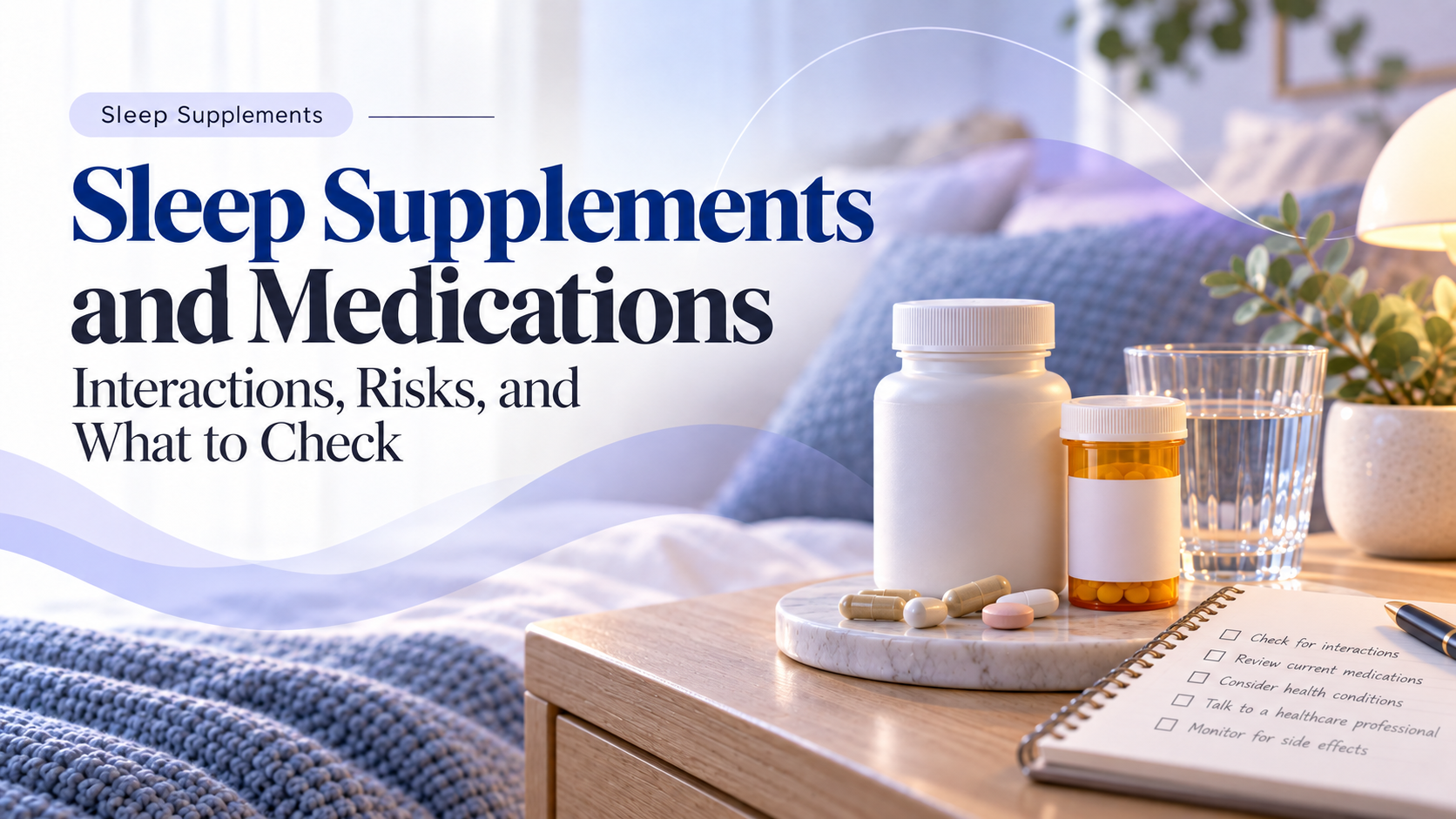
A Simple Interaction Check Before Buying
Before purchasing a sleep supplement, write down:
- Every prescription medication you take.
- Over-the-counter medicines you use regularly.
- Other supplements and herbal products.
- The exact sleep product and full ingredient list.
- The amount per serving.
- How often you plan to use it.
This gives a pharmacist or clinician something specific to evaluate rather than asking whether “sleep supplements” in general are safe with your medication.
When Professional Review Is Especially Important
Interaction review becomes especially important if an adult:
- Takes several prescription medicines.
- Uses medication that already causes drowsiness or dizziness.
- Uses anticoagulant or antiplatelet medication.
- Has kidney or liver disease.
- Uses several supplements or combination formulas.
- Is considering regular long-term use.
If you are comparing products before purchase, our adult sleep supplement buyer’s checklist also includes ingredient transparency, quality claims, cost, and interaction questions.
Frequently Asked Questions
Can Sleep Supplements Interact With Prescription Medications?
Yes. The type of interaction depends on the exact supplement and medication. Possible concerns include additional sedation, altered absorption, bleeding-related effects, and other ingredient-specific interactions.
Can You Take Valerian Root With Melatonin?
There is no universal answer that applies to every adult. Valerian and melatonin are different substances, but both may affect sleepiness or alertness. Combining them may increase drowsiness, dizziness, impaired coordination, or next-day impairment in some people.
Check the full labels, amounts, other supplements, and medications involved. If you take regular medication or other sedating substances, professional review is especially useful before combining them.
Can You Take Melatonin With Prescription Sleep Medication?
Do not assume the combination is safe. Depending on the prescription medication and melatonin product involved, combining them may increase sedation or other effects. Review the exact combination with the prescribing clinician or a pharmacist.
Can Magnesium Interfere With Medication?
Yes. Supplemental magnesium can interfere with the absorption of certain medicines. Depending on the medication, spacing doses apart may be necessary. Check the instructions for the exact medicine or ask a pharmacist.
If No Interaction Is Listed, Does That Mean the Combination Is Safe?
Not necessarily. Some supplement combinations have limited interaction data. Absence of a well-documented interaction is not the same as proof that no interaction is possible.
Should I Stop My Medication Before Trying a Sleep Supplement?
No. Do not stop, reduce, or replace prescription medication in order to start a supplement without discussing the change with the clinician who manages that medication.
Bottom Line
Sleep supplements and medications should not be evaluated independently when they are taken together.
Melatonin, magnesium, valerian, chamomile, L-theanine, and multi-ingredient formulas can create different interaction concerns, including additional sedation, altered absorption, bleeding-related effects, and uncertainty when several active substances are combined.
The most practical approach is to compare the complete supplement label with the complete medication list, include other supplements and alcohol in the review, and ask a pharmacist or clinician about the exact combination when interaction risk is uncertain.
References
-
National Center for Complementary and Integrative Health.
Herb-Drug Interactions: What the Science Says. -
National Center for Complementary and Integrative Health.
Melatonin: What You Need To Know. -
National Center for Complementary and Integrative Health.
Valerian. -
National Center for Complementary and Integrative Health.
Chamomile. -
NIH Office of Dietary Supplements.
Magnesium: Fact Sheet for Health Professionals. -
U.S. Food and Drug Administration.
Mixing Medications and Dietary Supplements Can Endanger Your Health.