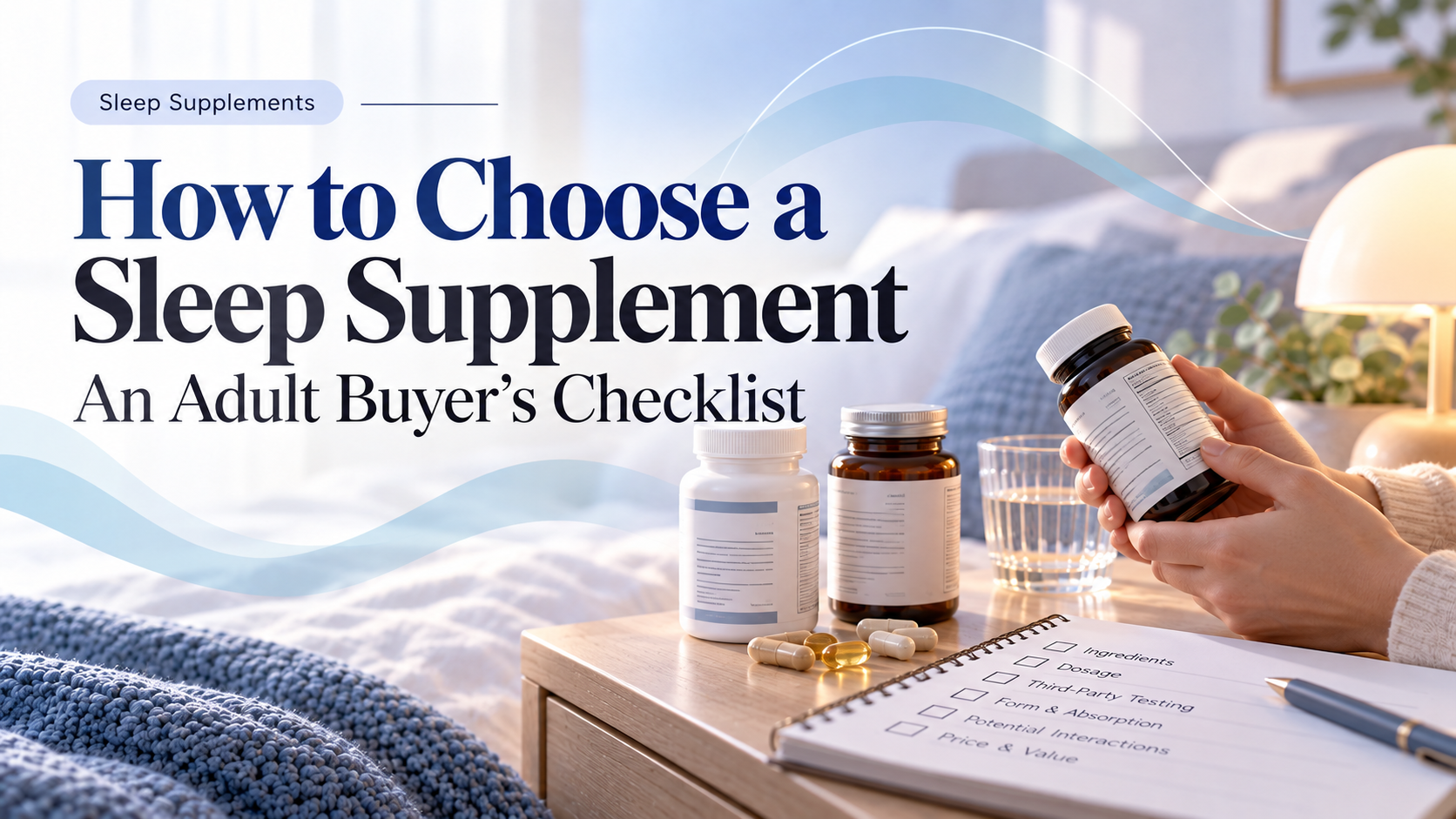
How to Choose a Sleep Supplement: An Adult Buyer’s Checklist
Medical disclaimer: This article is for general educational purposes only and is not a substitute for medical advice. Sleep supplements can cause side effects and interact with medications or other supplements. If you take medication, have a medical condition, or have persistent sleep problems, consider discussing a product with a pharmacist or other qualified healthcare professional.
Editorial scope:
This is an educational, evidence-informed article. It does not represent personal product testing or an individualized clinical assessment.
Choosing a sleep supplement can be surprisingly difficult. Two products may both promise “better sleep” while containing completely different ingredients, different amounts, different serving sizes, and very different levels of label transparency.
A useful buying process therefore starts before the marketing claims. Instead of asking which bottle looks most impressive, compare what the product actually contains, what is known about those ingredients, what one serving costs, and what purchasing terms apply.
If you are new to this category, our general guide to natural sleep supplements explains the main ingredient types, evidence questions, and safety considerations before you begin comparing individual products.
In this guide
1. Start With the Supplement Facts Label
The front of the bottle is marketing. The Supplement Facts panel is where the useful comparison begins.
Before comparing claims, identify:
- The serving size.
- Every listed active ingredient.
- The amount of each ingredient when disclosed.
- Other ingredients such as sweeteners, flavors, fillers, or capsule materials.
- The number of servings in the package.
Do not assume that two products with similar front-label wording contain comparable formulas.
2. Check Whether Ingredient Amounts Are Transparent
Knowing that a product contains melatonin, magnesium, valerian, L-theanine, or another ingredient is only part of the picture. The amount matters when comparing products and evaluating evidence.
A transparent label lets you identify the amount of each important active ingredient rather than forcing you to evaluate a formula based only on its ingredient names.
Transparency does not prove that a formula is effective, but it makes meaningful comparison possible.
3. Be Careful With Proprietary Blends
A proprietary blend may list several ingredients under one combined total amount without showing how much of each ingredient is present.
That does not automatically make the product poor quality or ineffective. It does, however, make it harder to compare the formula with research, identify duplicate intake, or compare it with competing products.
When two otherwise similar products are being compared, full ingredient disclosure is generally more informative than a blend that hides individual amounts.
4. Look for Duplicate Ingredients
Sleep products often contain ingredients that also appear in multivitamins, magnesium supplements, relaxation formulas, nighttime beverages, or other supplements.
Before adding a new product, compare all of your supplement labels. Two separate products can contain the same ingredient even when they are marketed for different purposes.
For more detail, see our guide to combining sleep supplements and checking ingredient overlap.
5. Separate Ingredient Evidence From Product Evidence
One of the most important distinctions in supplement shopping is the difference between evidence for an ingredient and evidence for a finished product.
A company may cite research involving melatonin, magnesium, valerian, or another ingredient. That does not automatically show that its finished multi-ingredient formula has been tested and shown to produce the same result.
When you see a research-based claim, ask whether the cited evidence studied the actual finished product, the same ingredient in another formulation, or simply an ingredient category.
Our sleep supplement evidence guide explains how evidence differs across common ingredients.
6. Do Not Treat “Natural” as a Quality Rating
Words such as “natural,” “clean,” “premium,” or “plant-based” can describe aspects of a product, but they are not evidence that the product is effective or safer for every adult.
Natural ingredients can still produce side effects, allergies, sedation, or medication interactions.
For broader safety questions, read our sleep supplement safety, risks, and interactions guide.
7. Understand What Third-Party Testing Can — and Cannot — Tell You
Quality or third-party testing can be useful information, but the phrase itself is too vague to evaluate without more detail.
If a company makes a testing claim, ask:
- Who performs the testing?
- What is tested?
- Does testing address ingredient identity or quantity?
- Does it address contaminants?
- Can the company provide documentation for the claim?
Even meaningful quality testing does not prove that the supplement improves sleep. Product identity, purity, and clinical effectiveness are different questions.
8. Compare Product Form
Sleep supplements are sold as capsules, tablets, gummies, powders, liquids, teas, and other formats.
The best format from a purchasing perspective is often the one that gives you clear ingredient information and fits how you prefer to use the product.
Gummies, for example, may be easier for some adults to use, but they may also include sweeteners, flavorings, or different serving sizes. Capsules may have fewer added ingredients but are not automatically superior.
9. Compare Cost per Serving — Not Just Bottle Price
A cheaper bottle is not necessarily the cheaper product.
One bottle may contain 60 capsules but require two capsules per serving. Another may contain 30 capsules with one capsule per serving. Both provide 30 servings.
A simple starting comparison is:
Cost per serving = Product price ÷ Number of servings
This does not tell you whether a product works, but it makes price comparisons more meaningful.
Check the Real Checkout Cost
The advertised price may not be the final amount you pay. Shipping, taxes, or other checkout charges can change the comparison between two products.
For a more realistic comparison, check:
- Product price.
- Shipping charges.
- Any applicable taxes or checkout fees.
- The number of servings actually provided.
One-Time Purchase vs Subscription Pricing
Some sleep supplements are sold at a lower displayed price when you enroll in a subscription rather than make a one-time purchase.
Before treating the subscription price as the true product price, check:
- The regular one-time purchase price.
- The subscription price.
- How often the subscription renews.
- Whether the first order uses an introductory discount that changes later.
- Whether shipping terms differ for subscription orders.
- How cancellation, skipping, or changing future orders works.
A subscription discount can reduce cost, but only if the renewal terms fit how you actually intend to buy and use the product.
Do Not Ignore Return and Refund Terms
Return and refund policies are part of the purchasing decision, especially when comparing products sold directly by different companies.
Look for details such as:
- How long the return window lasts.
- Whether opened products are eligible.
- Who pays return shipping.
- Whether subscription orders follow different rules.
- Whether refunds exclude shipping or other charges.
A generous refund policy may reduce purchasing risk, but it does not prove that a supplement is effective, high quality, or appropriate for you.
10. Watch for Marketing Claims That Need Context
Marketing phrases that deserve closer examination include:
- “Clinically studied.”
- “Doctor formulated.”
- “Scientifically backed.”
- “Premium ingredients.”
- “Supports deep sleep.”
These phrases are not automatically false, but they need context. Ask what was studied, whether the finished product was tested, and what outcome was actually measured.
Avoid treating endorsements, testimonials, or customer reviews as equivalent to clinical evidence.
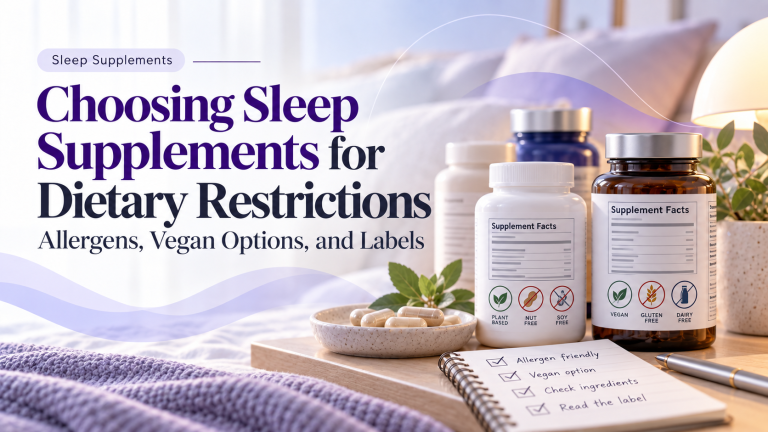
11. Check Dietary and Allergen Requirements
A formula may fit your ingredient preferences but still contain capsule materials, flavorings, sweeteners, or other ingredients that conflict with dietary restrictions or allergies.
Check the complete label rather than relying only on front-label terms such as vegan, gluten-free, or allergen-friendly.
Our guide to dietary restrictions, allergens, and supplement labels covers this in more detail.
12. Review Medications and Other Supplements Before Buying
Before buying a new sleep product, review what you already take.
Medication interactions can involve additional sedation, altered absorption, bleeding-related concerns, or other ingredient-specific effects.
See our sleep supplements and medication interactions guide for a dedicated review of this issue.
A Simple Sleep Supplement Buyer’s Checklist
Before purchasing, ask:
- What exact ingredients are included?
- Are the individual ingredient amounts disclosed?
- Does the product use a proprietary blend?
- What is the serving size?
- Does it duplicate another supplement I already use?
- What evidence exists for the ingredients?
- Has the finished product itself been studied, or only its ingredients?
- What exactly do quality or third-party testing claims mean?
- Does the label fit my dietary and allergen requirements?
- Could it interact with medication or another supplement?
- What is the cost per serving?
- What is the total checkout cost?
- Is the advertised price tied to a subscription?
- What are the renewal and cancellation terms?
- What is the return or refund policy?
How We Apply This Checklist in Product Reviews
Our product reviews use this framework to evaluate observable characteristics such as ingredient disclosure, serving size, evidence, safety considerations, product form, cost, and purchasing terms.
We do not assume that a product is effective simply because individual ingredients have been studied, and we do not claim personal product testing unless that testing actually occurred and is clearly disclosed.
Some reviews may contain affiliate links. If you purchase through an eligible affiliate link, Natural Sleep Hub may earn a commission at no additional cost to you. Affiliate relationships do not change the evaluation criteria used in the review.
For an example of how this framework is applied to a real supplement product, see our YU Sleep review.
For a non-supplement product review using the same principles of evidence separation, claim verification, and purchase-term checking, see our Purple Harmony Pillow review.
Frequently Asked Questions
Does Having More Ingredients Make a Sleep Supplement Better?
No. More ingredients can also mean more overlap, more uncertainty, and more difficulty identifying which ingredient is responsible for an effect or side effect. Evaluate each ingredient and the finished formula rather than counting ingredients.
Is a Proprietary Blend Automatically Bad?
No. The main limitation is transparency. If individual ingredient amounts are not disclosed, comparing the product with research or another formula becomes more difficult.
Does Third-Party Testing Prove That a Sleep Supplement Works?
No. Testing may provide information about identity, quantity, purity, or contaminants depending on what was tested. It does not by itself demonstrate that the product improves sleep.
Are Gummies Better Than Capsules?
Not inherently. The better comparison is the complete formula, serving size, added ingredients, transparency, cost, and how well the format fits your preferences.
Should I Choose a Supplement Based on My Sleep Symptoms?
Be cautious about diagnosing the cause of a persistent sleep problem from symptoms alone. Different sleep disorders and health conditions can produce similar complaints. A supplement-buying checklist can help compare products, but it cannot determine the cause of insomnia or other ongoing sleep problems.
Is a Subscription Price Always the Cheapest Option?
Not necessarily. A subscription may reduce the price per order, but renewal frequency, shipping, introductory discounts, cancellation rules, and how much product you actually use can change the real cost.
Does a Money-Back Guarantee Mean the Product Works?
No. A return or refund policy is a purchasing term. It may reduce financial risk, but it is not evidence of effectiveness, safety, or product quality.
Bottom Line
A useful sleep supplement buying decision is based on more than a brand name, bottle price, or marketing promise.
Compare exact ingredients, disclosed amounts, serving size, evidence, quality claims, dietary requirements, medication interactions, cost per serving, total checkout cost, subscription terms, and refund policies.
The goal is not to identify a universal “best” sleep supplement. It is to make the differences between products visible enough that you can evaluate them more carefully and recognize when a pharmacist or clinician should be part of the decision.
References
-
U.S. Food and Drug Administration.
FDA 101: Dietary Supplements. -
U.S. Food and Drug Administration.
Information for Consumers on Using Dietary Supplements. -
U.S. Food and Drug Administration.
Mixing Medications and Dietary Supplements Can Endanger Your Health. -
National Center for Complementary and Integrative Health.
Sleep Disorders and Complementary Health Approaches.