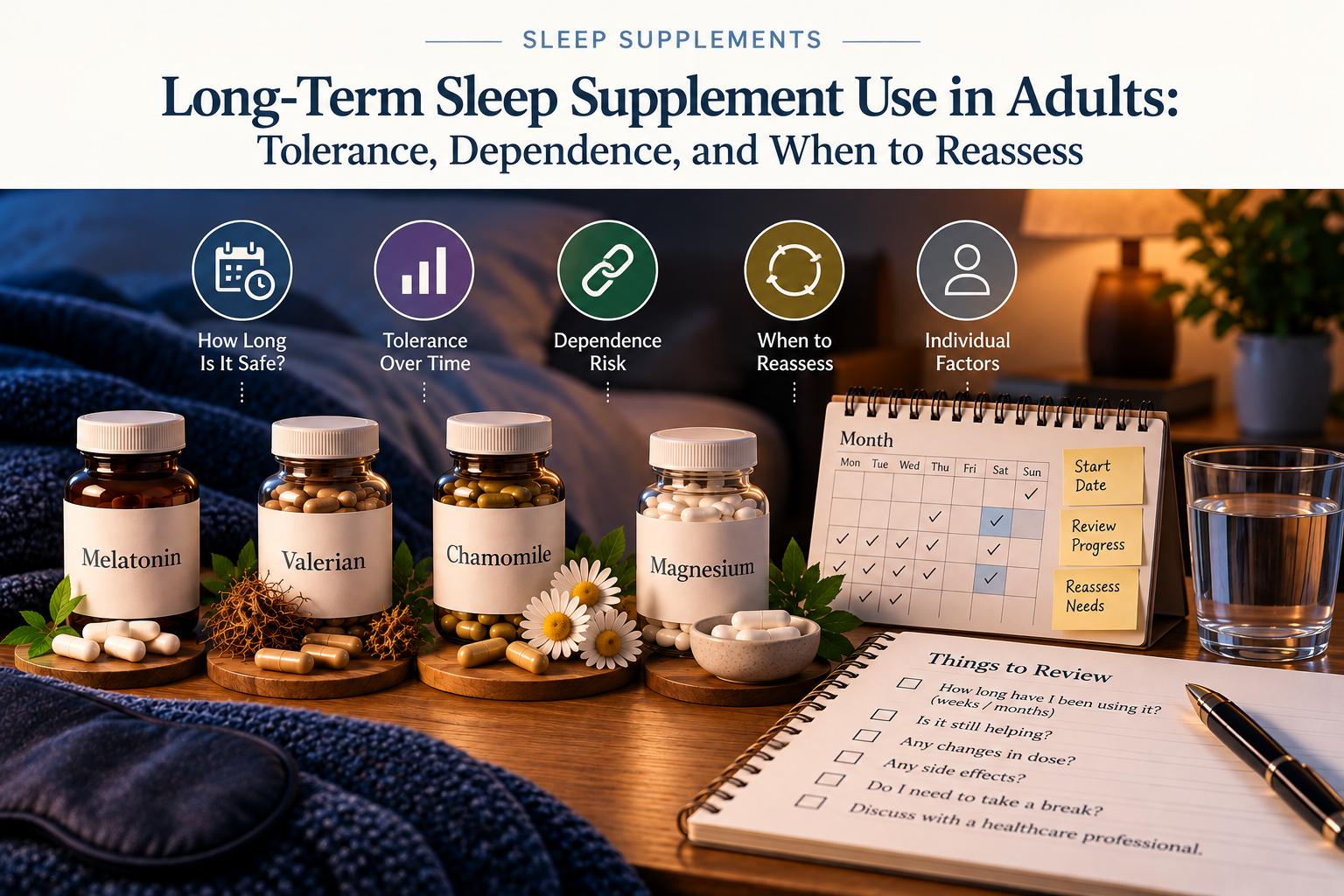
Long-Term Sleep Supplement Use in Adults: Tolerance, Dependence, and When to Reassess
Medical disclaimer: This article is for general educational purposes only and is not a substitute for medical advice. Long-term safety varies by ingredient, formulation, dose, health status, medications, and reason for use. Do not stop or change prescription treatment based on this article. If you use a sleep supplement regularly or have persistent sleep problems, consider discussing ongoing use with a pharmacist or other qualified healthcare professional.
Editorial scope:
This is an educational, evidence-informed article. It does not represent personal product testing or an individualized clinical assessment.
A sleep supplement that seems helpful for a few nights can easily become part of a nightly routine.
That does not automatically mean long-term use is unsafe. But it also does not mean that indefinite use is appropriate, necessary, or well studied.
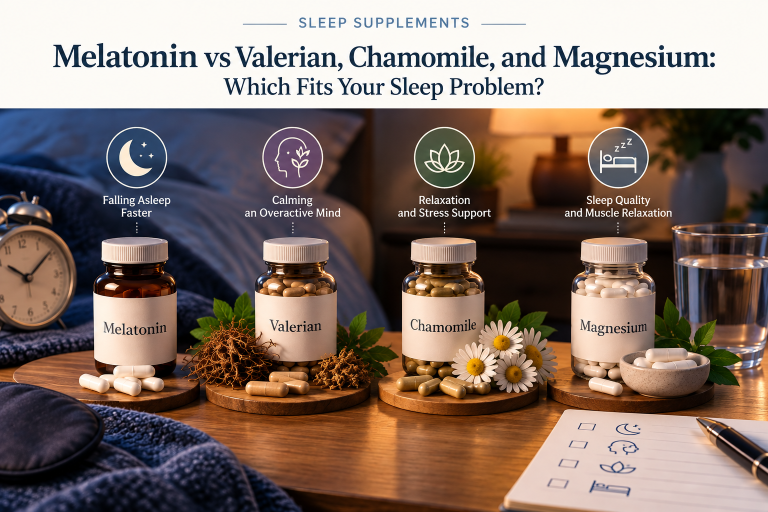
Melatonin, magnesium, valerian, chamomile, L-theanine, and multi-ingredient sleep formulas differ substantially in how much long-term evidence exists, what side effects may occur, and whether tolerance, dependence, or interaction concerns are relevant.
The most useful question is not simply “Can I take this every night?” It is: “Do I still need it, what is known about longer-term use of this exact product or ingredient, and is the underlying sleep problem being addressed?”
In this guide
Long-Term Use Means More Than Simply Taking a Supplement for Many Nights
There is no single definition of long-term use that applies equally to every sleep supplement.
A study lasting several weeks does not automatically answer questions about use for many months or years. Likewise, short-term tolerability does not prove long-term safety.
When evaluating ongoing use, consider:
- How long the ingredient has actually been studied.
- Whether the exact formulation has been studied.
- Whether the amount has changed over time.
- Whether side effects have appeared gradually.
- Whether new medications or supplements have been added.
- Whether the original sleep problem is still present.
Tolerance, Dependence, Withdrawal, and Habit Are Not the Same Thing
These terms are often used interchangeably in consumer discussions, but they describe different issues.
Tolerance
Tolerance generally means that the same amount produces less effect over time, leading someone to consider increasing the amount.
Physical Dependence
Physical dependence means the body has adapted to a substance and stopping it may produce withdrawal symptoms.
Psychological Reliance
A person can also become convinced that sleep is impossible without a product even when physical dependence is not established.
Withdrawal
Withdrawal refers to symptoms that occur after stopping or reducing a substance after the body has adapted to it.
These concepts should not be assumed to apply equally to every supplement.
Melatonin and Long-Term Use
Melatonin is one of the most widely used sleep supplements, but long-term questions still require context.
Short-term use has been studied more extensively than indefinite nightly use, and the quality of long-term evidence varies by population and purpose.
It is also important to remember that melatonin is involved in circadian timing. If it is being used for a timing problem, when it is taken can matter as much as how much is taken.
For that separate question, see our sleep supplement timing and onset guide.
Magnesium and Ongoing Use
Magnesium is an essential mineral, but that does not mean more supplemental magnesium is automatically better over time.
Supplemental magnesium can cause gastrointestinal effects, and kidney function is relevant because the body normally relies on the kidneys to help regulate magnesium balance.
Magnesium can also interfere with absorption of certain medications, so long-term use should be considered alongside the complete medication list.
Valerian and Long-Term Use
Valerian has a long history of traditional use, but long-term safety evidence is more limited than many consumers may assume from its widespread availability.
Different valerian products can also differ in extraction, concentration, and formulation, which makes broad conclusions more difficult.
Because valerian may contribute to sedation, ongoing use should also be evaluated in the context of alcohol, sedating medication, and other sleep products.
Chamomile, L-Theanine, and Other Ingredients
Chamomile and L-theanine are also common in sleep and relaxation products, but the amount and quality of long-term evidence vary.
A lack of documented long-term problems should not automatically be interpreted as proof of long-term safety, especially when a product combines several active ingredients.
This is particularly relevant for proprietary blends where the individual amounts are not disclosed.
Multi-Ingredient Formulas Create More Long-Term Uncertainty
A product containing one clearly disclosed ingredient is usually easier to reassess than a formula containing many active substances.
With combination products, ask:
- Are all ingredient amounts disclosed?
- Has the finished formula itself been studied long term?
- Do any ingredients duplicate other supplements?
- Could several ingredients contribute to sedation?
- Has the medication list changed since the product was started?
Our guide to combining sleep supplements covers ingredient overlap and combination risks in more detail.
Increasing the Amount Over Time Is a Reason to Reassess
If a supplement seems less effective than it once did, simply increasing the amount is not always the best response.
The change could reflect tolerance, a change in the underlying sleep problem, medication changes, stress, schedule disruption, or other factors.
Increasing intake can also increase side effects and interaction risks without guaranteeing better sleep.
For more context, see our sleep supplement dosage guide.
Regular Use Can Become a Substitute for Investigating the Sleep Problem
One of the most important long-term risks is not necessarily the supplement itself. It is the possibility that ongoing self-treatment delays evaluation of persistent sleep difficulty.
Ongoing sleep problems may relate to:
- Chronic insomnia.
- Circadian timing problems.
- Sleep-disordered breathing.
- Pain or other medical conditions.
- Medication effects.
- Mental health or behavioral factors.
If the supplement has become a permanent nightly response to an unresolved sleep problem, reassessment becomes more important.
CBT-I May Be More Relevant Than Another Long-Term Sleep Product
For adults with chronic insomnia, cognitive behavioral therapy for insomnia, or CBT-I, is an important evidence-based treatment.
The 2025 VA/DoD Clinical Practice Guideline recommends CBT-I for chronic insomnia disorder and suggests CBT-I over pharmacotherapy as first-line treatment.
This matters because repeatedly changing supplements can distract from a treatment that addresses the behavioral and cognitive processes that help maintain insomnia.
See our guide to sleep supplements alongside CBT-I for a closer comparison.
Medication Interactions Can Change Over Time
A combination that was reviewed months ago may need another look if medications, doses, supplements, or health conditions change.
This is particularly important when a sleep supplement becomes part of a long-term routine and is no longer thought of as something worth mentioning during medication review.
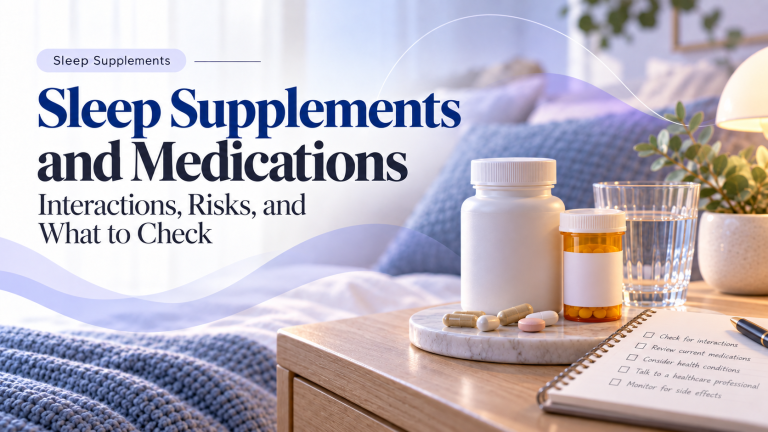
Our sleep supplements and medication interactions guide explains the main interaction questions.
A Practical Reassessment Checklist
If you have been using a sleep supplement regularly, ask:
- Why did I start taking it?
- Is that sleep problem still present?
- Am I taking more than when I started?
- Have I added other supplements with overlapping ingredients?
- Have my medications changed?
- Do I still know the exact ingredients and amounts?
- Am I experiencing next-day drowsiness, dizziness, or other side effects?
- Am I continuing mainly because I am afraid I cannot sleep without it?
- Would the persistent sleep problem benefit from professional evaluation?
If you are reviewing whether the product itself is still worth buying, our adult sleep supplement buyer’s checklist can help you reassess ingredient transparency, evidence, quality claims, cost, and purchase terms.
When Professional Review Is Especially Useful
Consider professional review if an adult:
- Has used a sleep supplement regularly for a prolonged period.
- Keeps increasing the amount.
- Uses several supplements or sedating products.
- Takes prescription medication.
- Has kidney or liver disease.
- Experiences persistent daytime sleepiness or other side effects.
- Still has chronic insomnia or another unresolved sleep problem.
Frequently Asked Questions
Is It Safe to Take Sleep Supplements Every Night?
There is no universal answer. Long-term safety depends on the specific ingredient, amount, formulation, medications, health conditions, and reason for use. Evidence for prolonged use also varies substantially between ingredients.
Can You Build a Tolerance to Sleep Supplements?
Tolerance should not be assumed to occur equally with every supplement. If you find yourself repeatedly increasing the amount because the same serving seems less effective, that is a reason to reassess rather than automatically increase intake.
Are Natural Sleep Supplements Non-Habit-Forming?
The phrase “non-habit-forming” can oversimplify the issue. Physical dependence, tolerance, withdrawal, and psychological reliance are different concepts, and they should be evaluated for the specific substance rather than assumed from the word “natural.”
Should I Stop a Sleep Supplement Suddenly?
That depends on the exact substance and your circumstances. Do not assume every supplement requires tapering, but do not assume abrupt stopping is appropriate for every product either. If you have used a product regularly for a long period or are concerned about withdrawal or rebound symptoms, discuss the specific product with a pharmacist or clinician.
When Should I Reassess a Sleep Supplement?
Reassessment is useful when use becomes regular, the amount increases, new medications are added, side effects appear, the supplement seems less effective, or the underlying sleep problem continues despite ongoing use.
What If I Still Cannot Sleep Without a Supplement?
If you feel unable to sleep without a supplement, that is a useful reason to reassess the situation. The issue may involve ongoing insomnia, psychological reliance, another sleep disorder, or another factor that deserves evaluation rather than repeated dose changes.
Bottom Line
Long-term sleep supplement use should not be treated as automatically safe or automatically dangerous.
The important questions are what ingredient or formula is being used, how much is taken, how long it has been used, whether medications or other supplements have changed, whether side effects or dose escalation have appeared, and whether the original sleep problem still needs evaluation.
Regular reassessment is more useful than assuming that a product should continue indefinitely simply because it once seemed helpful.
References
-
National Center for Complementary and Integrative Health.
Melatonin: What You Need To Know. -
National Center for Complementary and Integrative Health.
Valerian. -
NIH Office of Dietary Supplements.
Magnesium: Fact Sheet for Health Professionals. -
U.S. Food and Drug Administration.
Mixing Medications and Dietary Supplements Can Endanger Your Health. -
U.S. Department of Veterans Affairs and Department of Defense.
VA/DoD Clinical Practice Guideline for the Management of Chronic Insomnia Disorder and Obstructive Sleep Apnea (2025). -
American Academy of Sleep Medicine.
Behavioral and Psychological Treatments for Chronic Insomnia Disorder in Adults.