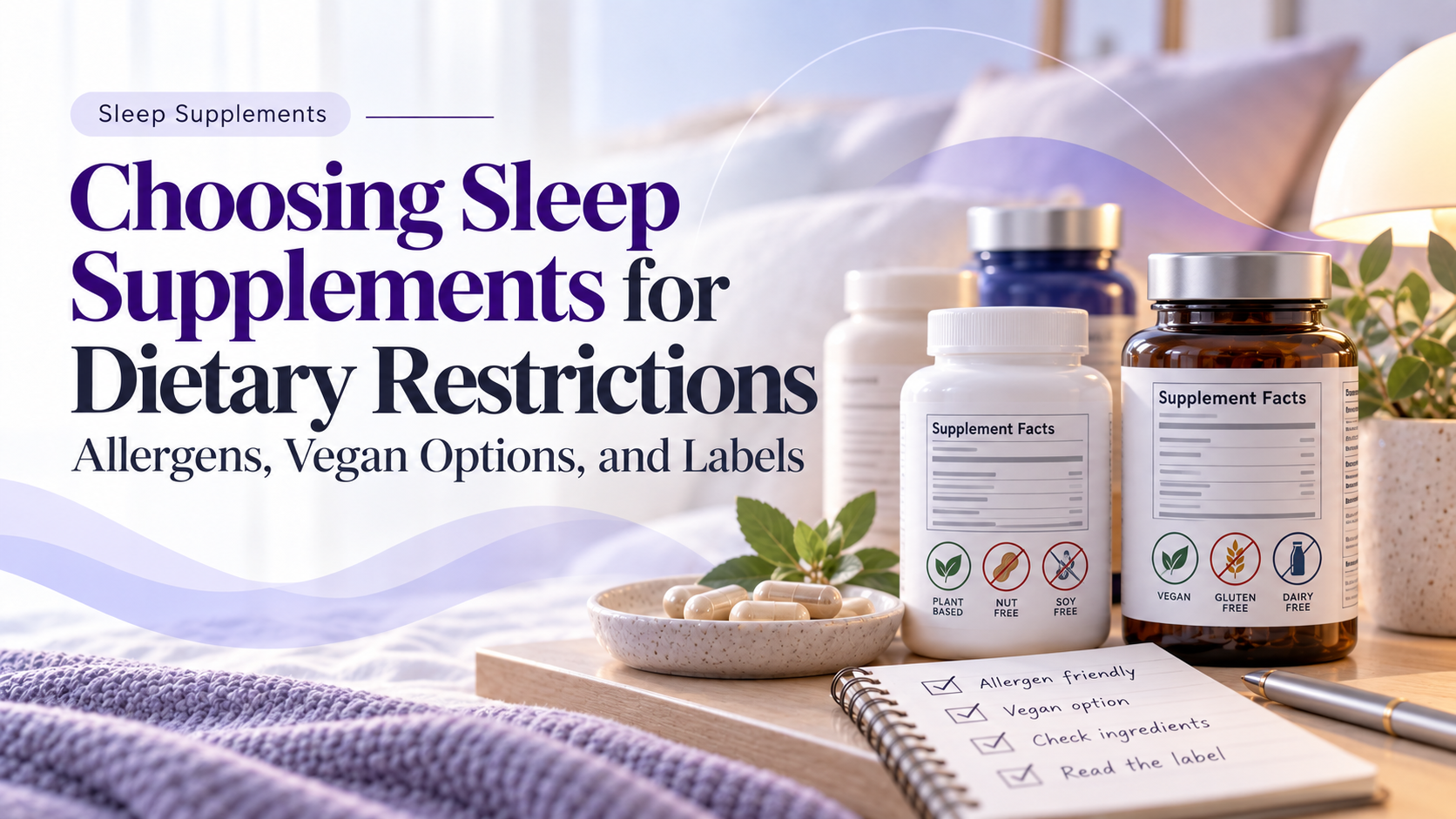
Choosing Sleep Supplements for Dietary Restrictions: Allergens, Vegan Options, and Labels
Medical disclaimer: This article is for general educational purposes only and is not a substitute for medical advice. Dietary restrictions, food allergies, medication use, and medical conditions can change which products are appropriate. If you have a serious allergy, celiac disease, a medically necessary dietary restriction, or take regular medication, review the exact product label and consider asking a pharmacist or other qualified healthcare professional before use.
Editorial scope:
This is an educational, evidence-informed article. It does not represent personal product testing or an individualized clinical assessment.
Choosing a sleep supplement is not only about the active ingredient.
For adults with allergies, vegan or vegetarian preferences, gluten concerns, religious dietary requirements, or other restrictions, the inactive ingredients, capsule material, flavoring, manufacturing statements, and allergen disclosures can matter just as much as the sleep ingredient itself.
A bottle can say “melatonin,” “magnesium,” or “herbal sleep support” on the front while still containing ingredients that do not fit a particular diet or restriction.
The practical rule is simple: do not judge dietary suitability from the front label alone.
In this guide
Start With the Full Supplement Facts and Ingredient List
The front of a supplement package is mainly a marketing surface. The more useful information is usually on the back or side panel.
Check:
- The Supplement Facts panel.
- The “other ingredients” list.
- Allergen statements.
- Capsule or gummy composition.
- Manufacturing or facility statements.
- Any certification relevant to your dietary restriction.
Our adult sleep supplement buyer’s checklist provides a broader framework for reading labels, comparing products, and checking quality claims.
“Vegan” and “Vegetarian” Are Not the Same Claim
A vegetarian product may still contain ingredients derived from animals.
For example, a capsule may use gelatin, which is animal-derived, while a plant-based capsule may use cellulose or another non-animal material.
A product labeled vegan should generally be evaluated separately from one labeled only vegetarian.
When vegan status matters, check:
- Capsule shell material.
- Gelatin or other animal-derived excipients.
- Flavorings or colorings with unclear sources.
- Whether the manufacturer explicitly states vegan status.
Capsule Material Is Easy to Miss
One of the most overlooked details is the capsule itself.
The active ingredient may be plant-based, while the capsule shell is made from gelatin.
This matters for vegan consumers and can also matter for people following religious dietary requirements.
If the label does not identify the capsule source clearly, do not assume it is plant-based.
Gluten-Free Claims Need More Than Guesswork
A sleep supplement may not obviously contain wheat or another gluten-containing grain, but that does not mean the product should automatically be treated as gluten-free.
Inactive ingredients, flavorings, processing aids, and manufacturing conditions can matter.
If avoiding gluten is medically necessary, look for a clear gluten-free statement and review manufacturer information rather than relying on the ingredient list alone.
Food Allergies Require More Care Than Food Preferences
A dietary preference and a serious food allergy are not the same situation.
For someone with a severe allergy, the consequences of relying on a vague label can be much more serious.
Potential concerns can include:
- Declared allergenic ingredients.
- Shared equipment or facilities.
- Flavorings or excipients with unclear sources.
- Product reformulation after a previous purchase.
If a severe allergy is involved, verify the current label each time you buy rather than assuming the formula has remained unchanged.
Common Allergen Statements Are Worth Reading Carefully
Labels may contain statements about milk, egg, fish, crustacean shellfish, tree nuts, peanuts, wheat, soy, sesame, or other ingredients and manufacturing conditions.
Do not look only at the active sleep ingredient.
Gummies, flavored powders, drink mixes, and chewables can contain more additional ingredients than a simple capsule or tablet.
Gummies Often Have More Dietary Variables
Gummies can be convenient, but they often include more formulation ingredients than capsules.
Depending on the product, that can include:
- Gelatin or pectin.
- Sugar or sugar alcohols.
- Flavorings.
- Color additives.
- Acids, coatings, or stabilizers.
A gummy can fit one restriction and fail another, so the complete formula matters.
Sugar-Free Does Not Mean Ingredient-Free
A sugar-free gummy or powder may use sugar alcohols or alternative sweeteners.
Some adults tolerate these well, while others may experience gastrointestinal discomfort from certain formulations.
If a product causes digestive symptoms, the inactive ingredients may be worth reviewing rather than assuming the active sleep ingredient is responsible.
“Natural” Does Not Tell You Whether a Product Fits Your Diet
The word “natural” does not tell you whether a product is vegan, gluten-free, allergen-free, halal, kosher, organic, or free from a specific ingredient.
Those are separate claims and should be evaluated separately.
For broader safety questions, see our sleep supplement safety guide.
Religious Dietary Requirements May Need Separate Verification
For adults following halal or kosher requirements, the active ingredient alone may not answer the question.
Capsule source, gelatin source, flavorings, processing aids, and manufacturing certification may matter.
If compliance is important, look for clear manufacturer information or recognized certification rather than inferring suitability from a short ingredient list.
A “Free From” Claim Should Be Specific
Statements such as “clean,” “pure,” or “all natural” are too vague to answer a dietary restriction question.
A more useful claim identifies the actual restriction, such as:
- Gluten-free.
- Vegan.
- Dairy-free.
- Soy-free.
- Free from a named allergen.
Even then, read the complete current label because formulas can change.
Third-Party Certification Can Help Clarify Some Claims
A recognized certification can provide more useful information than an unsupported marketing statement.
But certification scope matters.
A quality-testing certification does not necessarily prove vegan status, and a vegan certification does not prove the product has been clinically shown to improve sleep.
Each claim should be interpreted only for what it actually verifies.
Multi-Ingredient Sleep Formulas Need Extra Label Review
Combination sleep products can contain melatonin, magnesium, herbs, amino acids, flavorings, sweeteners, and inactive ingredients in one formula.
That creates more opportunities for a product to conflict with a dietary restriction.
It also creates more safety variables.
Our guide to combining sleep supplements explains why multi-ingredient formulas need more careful review.
Dietary Suitability Does Not Prove Effectiveness
A product can perfectly fit a vegan, gluten-free, or allergen-related requirement and still have weak evidence for improving sleep.
Dietary compatibility and effectiveness are separate questions.
For the evidence side of the decision, see our guide to what the evidence really shows about natural sleep supplements.
Dietary Suitability Does Not Prove Safety Either
A product can be vegan and gluten-free while still interacting with medication or causing side effects.
Likewise, an allergen-free product can still contain an amount or ingredient that is inappropriate for a particular adult.
If you use regular medication, see our sleep supplements and medication interactions guide.
Check the Current Label Every Time You Repurchase
Supplement formulas can change.
A product that fit your dietary needs when you first purchased it may later use a different capsule, sweetener, flavoring, or other ingredient.
This is especially important when the restriction is medically necessary rather than simply a preference.
A Practical Dietary-Restriction Checklist
Before buying a sleep supplement, ask:
- What are all the active ingredients?
- What are the inactive ingredients?
- What is the capsule, gummy, or coating made from?
- Is there a clear allergen statement?
- Does the manufacturer explicitly state vegan, vegetarian, gluten-free, or another relevant status?
- Is the claim independently certified, or only marketing language?
- Does the product use shared equipment or facilities relevant to my allergy?
- Has the formula changed since my last purchase?
- Does the product also fit my medication and safety profile?
Frequently Asked Questions
Are Melatonin Supplements Vegan?
Some are and some are not. The active melatonin does not tell you whether the finished product is vegan. Check the capsule or gummy ingredients, gelatin use, flavorings, and the manufacturer’s current vegan statement.
Are Sleep Supplements Usually Gluten-Free?
Do not assume so. Many products may not contain obvious gluten ingredients, but medically necessary gluten avoidance requires checking the current label and manufacturer information for the exact product.
What Is the Difference Between Vegan and Vegetarian Capsules?
A vegan capsule should avoid animal-derived ingredients, while vegetarian labeling may allow some animal-derived substances depending on the product and claim. Check the actual capsule material rather than relying only on a broad front-label term.
Can Sleep Gummies Contain Gelatin?
Yes. Some gummies use gelatin, while others use plant-based gelling agents such as pectin. Check the ingredient list and vegan or vegetarian statement if the source matters to you.
Does “Natural” Mean Allergen-Free?
No. “Natural” does not establish that a product is free from a particular allergen, gluten, animal-derived ingredients, or other restricted substances.
Should I Trust an Old Product Label I Found Online?
Not when a dietary restriction is important. Formulas and packaging can change. Use the current label for the exact product being purchased and confirm with the manufacturer when necessary.
Bottom Line
Dietary suitability is a product-level question, not just an ingredient-level question.
A melatonin, magnesium, valerian, or herbal product may contain capsule materials, flavorings, sweeteners, allergens, or other inactive ingredients that change whether it fits a vegan, gluten-free, allergen-related, or religious dietary requirement.
Read the complete current label, distinguish specific claims from vague marketing language, verify important restrictions directly when necessary, and remember that dietary compatibility does not by itself prove effectiveness or safety.
References
-
U.S. Food and Drug Administration.
Food Allergies. -
U.S. Food and Drug Administration.
FDA 101: Dietary Supplements. -
U.S. Food and Drug Administration.
Information for Consumers on Using Dietary Supplements. -
U.S. Food and Drug Administration.
Mixing Medications and Dietary Supplements Can Endanger Your Health.