YU Sleep Ingredients Explained: Formula & Evidence
Editorial note: This ingredient analysis is based on the YU Sleep Supplement Facts label, publicly available seller information, and independent research on the individual ingredients. We have not personally tested YU Sleep. Research on an individual ingredient should not be treated as proof that the complete YU Sleep formula produces the same effect.
Medical disclaimer: YU Sleep is a dietary supplement and is not a treatment for insomnia or another sleep disorder. This article is for general educational purposes only. If you take medications, use other supplements, have a medical condition, are pregnant or nursing, or have persistent sleep problems, review the complete formula with a qualified healthcare professional before use.
Affiliate disclosure: This article contains affiliate links. Natural Sleep Hub may earn a commission from an eligible purchase at no additional cost to you. Affiliate relationships do not change our editorial analysis.
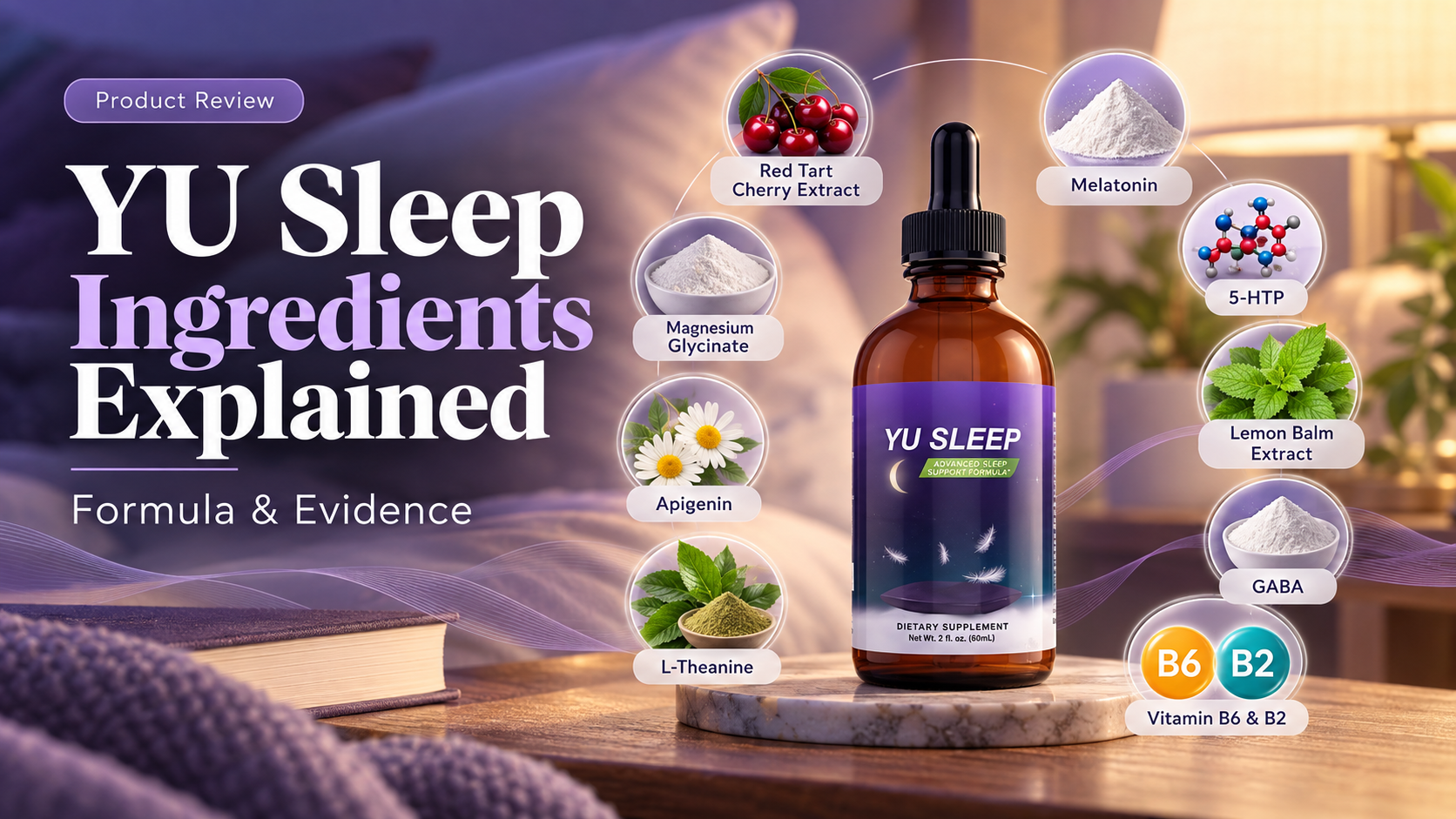
YU Sleep combines melatonin with vitamins B2 and B6 and a seven-ingredient proprietary blend. The formula includes several ingredients frequently marketed for sleep or relaxation, including magnesium glycinate, L-theanine, tart cherry, lemon balm, apigenin, 5-HTP, and GABA.
The important question is not simply whether these ingredients appear on the label. It is how much of each ingredient is disclosed, what independent research actually supports, and what cannot be concluded from the finished formula.
The clearest number on the label is the 0.9 mg melatonin dose. By contrast, seven other ingredients share a single 637 mg proprietary blend, so their individual quantities cannot be determined from the public Supplement Facts panel.
This article examines the formula ingredient by ingredient. For our broader assessment of the complete product, see our full YU Sleep review.
In this guide
YU Sleep Formula at a Glance
| Ingredient | Amount per serving | Transparency |
|---|---|---|
| Vitamin B2 | 0.5 mg | Fully disclosed |
| Vitamin B6 | 0.5 mg | Fully disclosed |
| Melatonin | 0.9 mg | Fully disclosed |
| Tart cherry, magnesium glycinate, apigenin, lemon balm, 5-HTP, L-theanine and GABA | 637 mg combined | Individual doses not disclosed |
The key point: 637 mg is the total weight of seven ingredients. It is not 637 mg of magnesium, L-theanine, tart cherry, or any other individual ingredient.
What the YU Sleep Supplement Facts Label Shows
The current label lists a serving size of 2 mL, or two full droppers, with approximately 30 servings per bottle.
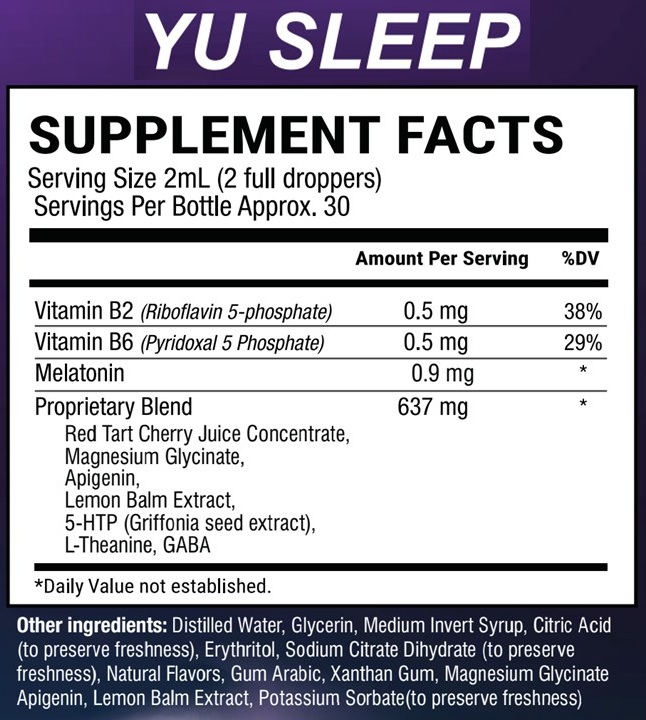
Three quantities are individually stated: vitamin B2 at 0.5 mg, vitamin B6 at 0.5 mg, and melatonin at 0.9 mg.
The remaining seven active ingredients appear under one proprietary-blend total of 637 mg.
Want to check the current YU Sleep label and offer?
Product information, packages, and purchase terms can change.
Visit the Official YU Sleep Website
Affiliate link. Natural Sleep Hub may earn a commission from an eligible purchase at no additional cost to you.
Melatonin — 0.9 mg Per Serving
Melatonin is the most transparent sleep-oriented ingredient in the YU Sleep formula because its amount is disclosed separately: 0.9 mg per 2 mL serving.
Melatonin is a hormone involved in the timing of the body’s circadian rhythm. Supplemental melatonin has been studied for several sleep and circadian situations, but the evidence does not mean that melatonin is a universal treatment for every form of insomnia.
Timing can also matter. The presence of melatonin on a label does not tell us that taking more will necessarily produce better sleep.
For YU Sleep specifically, the useful point is that the 0.9 mg quantity can be evaluated independently. That is different from the ingredients hidden within the proprietary blend.
Red Tart Cherry Juice Concentrate
Tart cherry is included as the first ingredient listed in the proprietary blend.
Tart cherries naturally contain several compounds of interest in sleep research, including melatonin and polyphenols. A 2025 systematic review found some positive sleep-related findings across intervention studies, but the researchers also emphasized that the evidence remains limited and heterogeneous, with substantial differences in dose, study duration, and participant populations.
This is especially relevant to YU Sleep because the product does not disclose the individual quantity of tart cherry concentrate. Even if a study used a particular amount of tart cherry, we cannot assume YU Sleep supplies the same amount.
Magnesium Glycinate
Magnesium is an essential mineral with important roles throughout the body and is commonly included in nighttime supplements.
However, magnesium’s popularity in sleep products is stronger than the certainty of the clinical evidence. Recent systematic reviews have found inconsistent results across trials, with low or very low certainty for many sleep outcomes.
There is another limitation when evaluating YU Sleep: the label says magnesium glycinate, but it does not tell us how much magnesium glycinate—or how much elemental magnesium—the serving provides.
We therefore cannot compare YU Sleep directly with magnesium doses used in clinical trials.
Apigenin
Apigenin is a naturally occurring flavonoid found in several plants, including chamomile.
It is frequently discussed in relation to calming and sleep because of its biological activity and possible interaction with pathways involved in relaxation. However, much of the mechanistic research is not equivalent to strong clinical evidence showing that isolated apigenin reliably improves sleep in humans.
Human evidence is also complicated by studies involving chamomile or other preparations that contain many compounds in addition to apigenin.
YU Sleep does not disclose its individual apigenin dose, so the amount cannot be compared directly with a research preparation.
Lemon Balm Extract
Lemon balm (Melissa officinalis) has a long history of use in calming preparations and has been studied for anxiety, stress, cognition, and sleep-related outcomes.
Human research provides some encouraging signals, but reviews continue to call for larger and more rigorous controlled studies. Some studies also combine lemon balm with other ingredients, making it difficult to isolate its independent contribution.
In YU Sleep, lemon balm is one component of the 637 mg proprietary blend, and its individual amount is not stated.
5-HTP
5-HTP, or 5-hydroxytryptophan, is a precursor involved in serotonin-related biochemical pathways. YU Sleep lists 5-HTP from Griffonia seed extract.
The presence of 5-HTP deserves particular attention for people who take medications that affect serotonin. Memorial Sloan Kettering notes potential interactions with serotonergic medications and advises medical supervision when 5-HTP is used alongside drugs such as SSRIs, MAOIs, tricyclic antidepressants, and other serotonergic agents.
Evidence specifically supporting 5-HTP as an insomnia treatment is limited.
Because YU Sleep does not disclose how much 5-HTP is present, the label does not allow a dose-specific assessment.
Medication note: If you take antidepressants, anxiety medications, other serotonergic drugs, or supplements that influence serotonin, do not assume that a multi-ingredient sleep supplement containing 5-HTP is automatically compatible with them.
L-Theanine
L-theanine is an amino acid naturally associated with tea and is widely marketed for relaxation without heavy sedation.
Among the ingredients in YU Sleep’s proprietary blend, L-theanine has a comparatively useful body of human research. A 2025 systematic review and meta-analysis reported improvements in several subjective sleep outcomes across randomized trials.
That does not tell us whether YU Sleep provides a research-comparable dose. Studies commonly investigate specified quantities of L-theanine, whereas YU Sleep does not disclose the ingredient’s individual amount.
Therefore, evidence supporting L-theanine as an ingredient should not be converted into evidence that the finished YU Sleep formula necessarily produces the same results.
GABA
GABA is an inhibitory neurotransmitter and is frequently included in products marketed for relaxation and sleep.
The important distinction is between the established role of GABA inside the nervous system and evidence for orally consumed GABA supplements.
A systematic review of human trials concluded that evidence for stress reduction from oral GABA was limited and evidence for sleep benefits was very limited.
YU Sleep also does not disclose its individual GABA dose, which makes comparison with individual studies impossible.
Vitamin B2 and Vitamin B6
Unlike most ingredients in the proprietary blend, YU Sleep individually discloses its vitamin quantities:
- Vitamin B2: 0.5 mg per serving.
- Vitamin B6: 0.5 mg per serving.
These are genuine nutritional ingredients, but their presence should not be interpreted as evidence that YU Sleep has been clinically demonstrated to improve sleep.
The primary sleep-focused evaluation of the formula still centers on ingredients such as melatonin and the components of the proprietary blend.
What About the Other Ingredients?
The product label also lists ingredients used in the liquid formulation and for characteristics such as texture, flavor, sweetness, acidity, and preservation.
These include distilled water, glycerin, medium invert syrup, citric acid, erythritol, sodium citrate dihydrate, natural flavors, gum arabic, xanthan gum, and potassium sorbate.
The label image also repeats magnesium glycinate, apigenin, and lemon balm extract in the “Other ingredients” line even though those ingredients are already listed in the proprietary blend. We do not interpret that visual repetition as evidence that additional quantities are provided beyond the 637 mg proprietary blend.
Why the 637 mg Proprietary Blend Matters
This is the most important limitation when evaluating the ingredient panel.
The label tells us that these seven ingredients together weigh 637 mg:
- Red tart cherry juice concentrate
- Magnesium glycinate
- Apigenin
- Lemon balm extract
- 5-HTP
- L-theanine
- GABA
But it does not tell us whether one ingredient makes up most of that 637 mg or whether the blend is distributed more evenly.
For example, research suggesting a benefit from a specific dose of L-theanine cannot tell us whether YU Sleep contains that amount. The same problem applies to magnesium, tart cherry, GABA, and the other proprietary-blend components.
A proprietary blend is a transparency limitation, not proof of a bad formula. It prevents a reader from independently checking whether individual ingredient doses match those studied in research.
YU Sleep Ingredient Evidence Summary
| Ingredient | What we can reasonably say | YU Sleep limitation |
|---|---|---|
| Melatonin | Established role in circadian timing; useful evidence exists for selected sleep and circadian situations. | Dose is disclosed at 0.9 mg, but that does not prove finished-product efficacy. |
| Tart cherry | Some positive sleep findings, but evidence remains limited and heterogeneous. | Individual amount unknown. |
| Magnesium | Research is mixed; evidence does not support treating magnesium as a routine insomnia therapy. | Magnesium glycinate and elemental magnesium quantities are unknown. |
| L-Theanine | Human trials and recent reviews report promising sleep-related outcomes. | Individual dose unknown. |
| GABA | Human evidence for oral GABA and sleep remains very limited. | Individual dose unknown. |
| 5-HTP | Insomnia evidence is limited; medication interactions deserve attention. | Individual dose unknown. |
| Lemon balm | Some encouraging calming and sleep-related research, but stronger controlled evidence is still needed. | Individual dose unknown. |
| Apigenin | Biologically interesting, but direct human sleep evidence for isolated apigenin remains limited. | Individual dose unknown. |
What Does This Mean for Someone Considering YU Sleep?
YU Sleep is not an ingredient-free marketing concept. It contains several compounds with legitimate scientific interest in sleep, circadian rhythm, relaxation, or related pathways.
But the strength of evidence varies substantially from ingredient to ingredient.
The 0.9 mg melatonin dose is transparent. The seven ingredients inside the proprietary blend are not individually quantified. That limits how confidently we can compare the product with clinical studies.
It also means that statements such as “L-theanine has research behind it” and “YU Sleep contains L-theanine” cannot logically be combined into “therefore YU Sleep has been clinically proven to work.”
For our assessment of safety, value, pros and cons, refund terms, and the product as a whole, read the complete YU Sleep review.
Frequently Asked Questions About YU Sleep Ingredients
What are the main ingredients in YU Sleep?
YU Sleep lists vitamin B2, vitamin B6, melatonin, red tart cherry juice concentrate, magnesium glycinate, apigenin, lemon balm extract, 5-HTP, L-theanine, and GABA.
How much melatonin is in YU Sleep?
The current Supplement Facts panel lists 0.9 mg of melatonin per 2 mL serving.
How much magnesium is in YU Sleep?
The exact amount is not disclosed. Magnesium glycinate is included in the seven-ingredient proprietary blend, which weighs 637 mg in total.
How much L-theanine is in YU Sleep?
The label does not disclose the individual L-theanine quantity. It is part of the 637 mg proprietary blend.
Does YU Sleep contain 5-HTP?
Yes. The label lists 5-HTP from Griffonia seed extract. The individual amount is not disclosed.
Does YU Sleep contain GABA?
Yes. GABA appears in the proprietary blend, but the label does not state how much GABA is present per serving.
Is YU Sleep’s proprietary blend a problem?
A proprietary blend is primarily a transparency limitation. It does not prove that a formula is ineffective, but it prevents independent dose-by-dose comparison with clinical studies.
Are all YU Sleep ingredients clinically proven for sleep?
No. Evidence differs considerably across the ingredients, and research on an individual ingredient is not equivalent to clinical evidence for the complete YU Sleep formula.
Bottom Line
The YU Sleep ingredient list contains several substances with plausible or researched connections to sleep and relaxation, but the formula has an important transparency limitation.
Melatonin is disclosed at 0.9 mg per serving. Vitamins B2 and B6 are also individually quantified. But red tart cherry, magnesium glycinate, apigenin, lemon balm, 5-HTP, L-theanine, and GABA are combined into a single 637 mg proprietary blend.
That makes it possible to discuss the evidence behind each ingredient, but impossible to confirm whether most of the individual doses correspond to quantities studied in clinical research.
For that reason, our interpretation is deliberately narrower than the seller’s marketing: the formula contains several scientifically interesting ingredients, but ingredient-level research should not be presented as proof of finished-product effectiveness.
Check the current YU Sleep formula and offer
Always compare the current label and checkout terms before deciding.
Visit the Official YU Sleep Website
Affiliate link. Natural Sleep Hub may earn a commission from an eligible purchase at no additional cost to you.
Sources & References
- YU Sleep. Current Supplement Facts label and product materials.
-
National Center for Complementary and Integrative Health.
Melatonin: What You Need To Know
. -
Lopresti AL, Smith SJ, Drummond PD.
Magnesium Supplementation for Sleep in Adults: A Systematic Review of Randomized Controlled Trials
. Journal of Dietary Supplements. 2026. -
Bulman A, et al.
The Effects of L-Theanine Consumption on Sleep Outcomes: A Systematic Review and Meta-Analysis
. Sleep Medicine Reviews. 2025. -
Barforoush F, et al.
The Effect of Tart Cherry on Sleep Quality and Sleep Disorders: A Systematic Review
. Food Science & Nutrition. 2025. -
Hepsomali P, Groeger JA, Nishihira J, Scholey A.
Effects of Oral GABA Administration on Stress and Sleep in Humans: A Systematic Review
. Frontiers in Neuroscience. 2020. -
Memorial Sloan Kettering Cancer Center.
5-HTP
. -
PubMed.
Unraveling the Effects of Melissa officinalis on Cognition and Sleep Quality
. 2025. -
PubMed.
Apigenin: A Natural Molecule at the Intersection of Sleep and Aging
. 2024.