Can You Drink Alcohol With Sleep Supplements? Risks and What to Check
Medical disclaimer: This article is for general educational purposes only and is not a substitute for medical advice. Alcohol can interact with supplements, medications, and health conditions in different ways. If you take prescription or over-the-counter medication, use several supplements, or have a medical condition, consider discussing the exact combination with a pharmacist or other qualified healthcare professional.
Editorial scope:
This is an educational, evidence-informed article. It does not represent personal product testing or an individualized clinical assessment.
Alcohol and sleep supplements are often used for the same general reason: to relax, feel sleepy, or make it easier to fall asleep.
That overlap is exactly why the combination deserves caution.
A sleep supplement may already cause drowsiness, dizziness, or reduced alertness. Alcohol can add another sedating effect and make the overall response less predictable.
The useful question is not simply “Can I drink alcohol with a sleep supplement?” It is: “What is in the supplement, what other medications or substances are involved, and could the combination increase sedation or impairment?”
In this guide
Why Alcohol Can Complicate Sleep Supplement Use
Alcohol can reduce alertness and coordination, and some sleep supplements can do the same.
When combined, possible concerns can include:
- Greater drowsiness.
- Dizziness.
- Reduced coordination.
- Slower reaction time.
- Next-day impairment.
- More difficulty predicting how strongly the combination will affect you.
For a broader overview of supplement risks, see our sleep supplement safety, risks, and interactions guide.
Alcohol May Make You Feel Sleepy Without Improving Sleep Quality
Alcohol can make some people feel sleepy at first, but feeling sedated is not the same as getting healthy, restorative sleep.
Sleep can become more fragmented later in the night, and alcohol can worsen certain sleep-related problems in susceptible adults.
That means using alcohol as a sleep strategy can create a misleading impression: falling asleep faster does not necessarily mean sleeping better.
Melatonin and Alcohol
Melatonin can cause sleepiness, dizziness, headache, or nausea in some adults.
Adding alcohol can make sedation or impairment harder to predict, particularly if other medications or supplements are also involved.
Melatonin also has a role in sleep-wake timing, so treating it simply as a sedative can miss part of how it works.
For timing questions, see our sleep supplement timing and onset guide.
Valerian and Alcohol
Valerian deserves particular caution because it is associated with sedating effects.
Combining valerian with alcohol may increase drowsiness or impairment, and the overall effect may be more difficult to predict if other sedating substances are also being used.
Different valerian products can also differ in concentration and formulation, which makes product-specific label review important.
Magnesium and Alcohol
Magnesium differs from sedating herbs because it is an essential mineral, but that does not mean the broader situation can be ignored.
If magnesium is part of a multi-ingredient sleep product, the other ingredients may be more relevant to alcohol-related sedation than magnesium itself.
Magnesium also has medication-interaction considerations of its own, particularly involving absorption of certain medicines.
Chamomile, L-Theanine, and Other Ingredients
Chamomile, L-theanine, and other relaxation ingredients may appear in formulas that are marketed as gentle or natural.
That wording should not be used as a shortcut for judging compatibility with alcohol.
The exact ingredient list, amount, individual response, and presence of medications or other sedating products all matter.
Multi-Ingredient Sleep Products Create More Uncertainty
A product may contain melatonin, valerian, L-theanine, GABA, magnesium, herbs, or several other ingredients in one serving.
Before combining such a product with alcohol, check:
- Every active ingredient.
- Whether individual amounts are disclosed.
- Whether several ingredients may contribute to sedation.
- Whether another supplement contains overlapping ingredients.
- Whether medication is also being used.
Our guide to combining sleep supplements explains ingredient overlap and multi-product uncertainty in more detail.
Prescription and Over-the-Counter Medications Add Another Layer of Risk
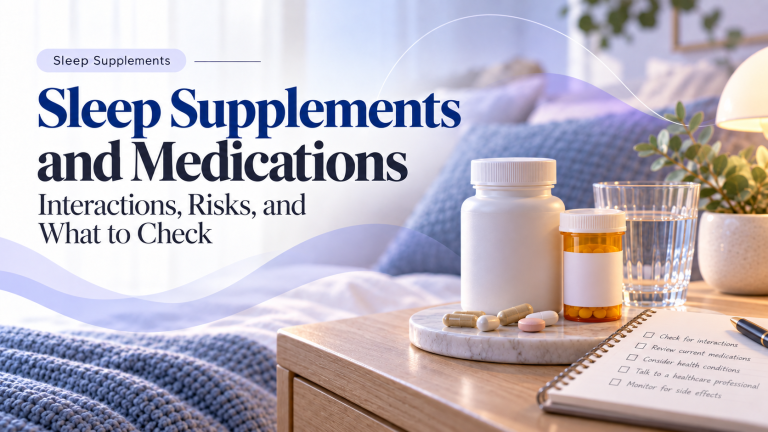
The most concerning scenario may not be alcohol plus one supplement alone. It may be alcohol, a sleep supplement, and a medication that also affects alertness.
Depending on the medication, this can increase sedation, dizziness, coordination problems, or other interaction risks.
This is why medication review should include supplements and alcohol rather than treating each one as a separate issue.
See our dedicated sleep supplements and medication interactions guide for more detail.
Do Not Use Alcohol as a Substitute for Sleep Treatment
If alcohol is being used repeatedly because falling asleep is difficult, the underlying sleep problem deserves attention.
Persistent insomnia may benefit from a broader approach that includes sleep habits, evaluation of underlying causes, and evidence-based treatment rather than repeated sedation.
For non-supplement approaches, see our guide to better sleep without supplements.
A Practical Check Before Drinking Alcohol
Before combining alcohol with a sleep supplement, review:
- The complete supplement label.
- Whether the product can cause drowsiness or dizziness.
- Whether multiple sedating ingredients are included.
- Any prescription or over-the-counter medicines being used.
- Other supplements taken the same evening.
- Whether you need to drive, work, or perform another activity requiring alertness.
If you cannot determine the interaction from the product and medication information, a pharmacist can review the exact combination.
When to Seek Prompt Medical Attention
Seek prompt medical attention if a combination of alcohol, supplements, or medication is followed by severe or unusual symptoms such as:
- Difficulty breathing.
- Fainting.
- Severe confusion.
- Extreme or unexpected sedation.
- Other severe or rapidly worsening symptoms.
Frequently Asked Questions
Can You Drink Alcohol With Melatonin?
The combination can make sedation or impairment harder to predict. Melatonin can cause sleepiness or dizziness in some adults, and alcohol can add to reduced alertness. Other medications or supplements can further increase uncertainty.
Can You Drink Alcohol With Valerian Root?
Valerian can have sedating effects, so combining it with alcohol may increase drowsiness and impairment. The risk becomes more important if other sedating substances or medications are also involved.
What About Alcohol and Magnesium?
Magnesium itself is different from a sedating herb, but many sleep products combine magnesium with other active ingredients. Evaluate the complete product rather than assuming that the presence of magnesium tells you whether alcohol is compatible with the formula.
Does Alcohol Help You Sleep Better?
Alcohol may make some people feel sleepy initially, but sedation is not the same as healthy sleep. Sleep can become more fragmented later in the night, so using alcohol as a sleep strategy can be misleading.
What If I Already Took a Sleep Supplement and Then Had Alcohol?
The appropriate response depends on the exact supplement, amount of alcohol, medications, symptoms, and individual circumstances. Avoid activities requiring alertness, and seek professional or urgent medical advice if severe or unusual symptoms occur.
Bottom Line
Alcohol and sleep supplements should not be treated as independent parts of a nighttime routine.
Melatonin, valerian, multi-ingredient formulas, medications, and alcohol can all contribute to sedation or impairment in different ways.
The practical approach is to check the complete supplement label, include medications and other supplements in the review, avoid assuming that “natural” means compatible with alcohol, and seek professional guidance when the combination is uncertain.
References
-
National Center for Complementary and Integrative Health.
Melatonin: What You Need To Know. -
National Center for Complementary and Integrative Health.
Valerian. -
National Center for Complementary and Integrative Health.
Chamomile. -
NIH Office of Dietary Supplements.
Magnesium: Fact Sheet for Health Professionals. -
U.S. Food and Drug Administration.
Mixing Medications and Dietary Supplements Can Endanger Your Health.