Can You Combine Sleep Supplements? Safety, Overlap, and What to Check
Medical disclaimer: This article is for general educational purposes only and is not a substitute for medical advice. Combining supplements can increase side effects or create interactions, especially if you also take prescription or over-the-counter medications. If you regularly use medication, have a medical condition, or experience persistent sleep problems, consider reviewing the exact products with a pharmacist or other qualified healthcare professional.
Editorial scope:
This is an educational, evidence-informed article. It does not represent personal product testing or an individualized clinical assessment.
It is common to see sleep formulas that combine several ingredients such as melatonin, magnesium, valerian, chamomile, L-theanine, GABA, or other calming compounds.
That can create the impression that combining several sleep supplements is simply a stronger version of taking one.
But more ingredients also mean more variables: overlapping effects, duplicated ingredients, higher total intake, harder-to-predict interactions, and less certainty about which ingredient is responsible for a benefit or side effect.
The key question is not simply “Can these supplements be taken together?” It is: What exactly is being combined, in what amounts, with what other medications or supplements, and for what reason?
In this guide
Why Combining Sleep Supplements Is More Complicated Than It Looks
Each sleep supplement has its own evidence, side effects, dosage questions, and interaction profile.
When several products are combined, new questions appear:
- Do the products contain the same ingredient?
- Could their sedating effects overlap?
- Does one product change absorption of another substance?
- Could the combination interact with medication?
- Are all ingredient amounts clearly disclosed?
- Has the combination itself ever been studied?
This is why evidence for two individual ingredients should not automatically be interpreted as evidence for taking them together.
Start by Checking for Duplicate Ingredients
One of the simplest mistakes is taking two products that contain the same ingredient.
For example, a nighttime blend may already contain melatonin or magnesium while a separate bottle contains the same ingredient again.
Before combining products, compare the complete labels and look for repeated ingredients such as:
- Melatonin.
- Magnesium.
- Valerian.
- L-theanine.
- Chamomile.
- Other calming or sedating ingredients.
Overlapping Sedation Is an Important Concern
Some sleep supplements can cause drowsiness or reduced alertness on their own.
Combining several products with similar effects may increase sleepiness, dizziness, impaired coordination, or next-day grogginess.
This becomes especially important if a person also uses prescription medication, over-the-counter nighttime medication, alcohol, or another sedating substance.
For broader safety information, see our sleep supplement safety, risks, and interactions guide.
Can You Take Melatonin With Valerian?
There is no universal answer that applies to every adult.
Melatonin and valerian are different substances, but both may affect sleepiness or alertness. Combining them could therefore increase drowsiness, dizziness, impaired coordination, or next-day effects in some people.
The product labels, exact amounts, other medications, and individual circumstances all matter.
Can You Take Melatonin With Magnesium?
Melatonin and magnesium are frequently sold together in commercial sleep products, but that does not mean every combination or amount is appropriate for every adult.
Magnesium also has its own dosage considerations and can interact with absorption of certain medications.
The fact that two ingredients appear in the same retail product should not be treated as proof that the combination is necessary or superior.
What About Melatonin and L-Theanine?
Melatonin and L-theanine also appear together in some sleep formulas.
However, evidence for an individual ingredient does not automatically establish that a specific combined product works better than either ingredient alone.
When evaluating such a formula, check whether the individual ingredient amounts are disclosed and whether the finished combination itself has been studied.
Proprietary Blends Make Combination Safety Harder to Evaluate
A proprietary blend may list several ingredients under one combined total without showing the amount of each component.
That makes it harder to determine whether another supplement duplicates one of the ingredients or pushes the total intake higher than expected.
A blend is not automatically unsafe or ineffective, but less transparency makes risk assessment and comparison more difficult.
Medication Interactions Can Matter More Than Supplement-to-Supplement Interactions
If you take prescription or over-the-counter medication, the interaction question becomes more important.
Potential concerns can include:
- Additive sedation.
- Changes in medication absorption.
- Bleeding-related effects.
- Effects on drug metabolism.
- Greater uncertainty when several active ingredients are combined.
Our dedicated sleep supplements and medication interactions guide covers this in more detail.
Alcohol Can Add Another Layer of Risk
Alcohol should not be treated as just another harmless part of a sleep routine when sedating supplements are involved.
Combining alcohol with substances that can reduce alertness may increase impairment or make effects less predictable.
Read our guide to alcohol and sleep supplements for more detail.
More Ingredients Do Not Automatically Mean Better Sleep
A longer ingredient list can look more comprehensive, but ingredient count is not evidence of effectiveness.
A formula with eight ingredients may be harder to evaluate than a formula with one or two clearly disclosed ingredients.
More ingredients can also make it harder to know what caused a side effect or whether every ingredient is necessary.
Dosage Still Matters When Products Are Combined
Even if two products can be considered separately, combining their labeled servings does not automatically establish that the combined amount is appropriate.
The total intake across all supplements matters, especially when duplicate ingredients are present.
For more context, see our sleep supplement dosage guide.
Timing Can Affect the Combination Too
How much you take and when you take it are separate questions.
Two products taken at the same time may produce more overlapping sedation than products used at different times, but timing decisions can also depend on the exact ingredient and intended goal.
See our sleep supplement timing and onset guide for that separate question.
How to Evaluate a Combination Product
Before buying or combining products, check:
- Every active ingredient.
- The amount of each ingredient.
- The serving size.
- Whether any ingredient is duplicated elsewhere.
- Whether the product uses a proprietary blend.
- Whether the finished formula has been studied.
- Medication and alcohol interaction concerns.
- Whether you actually need several ingredients for your goal.
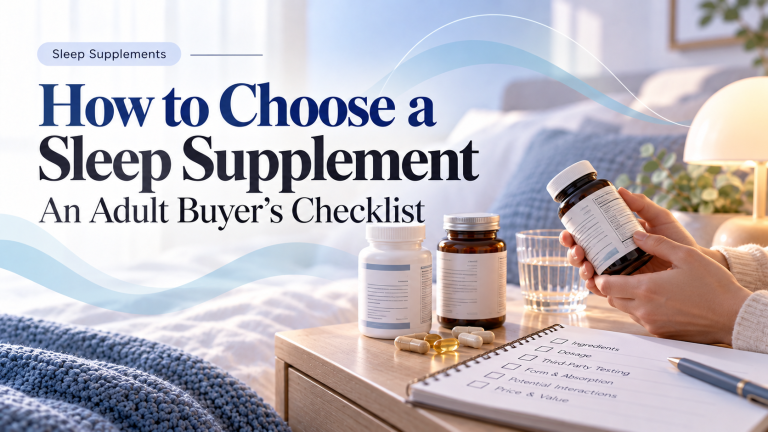
Our adult sleep supplement buyer’s checklist provides a broader framework for comparing real products.
When Professional Review Is Especially Useful
A pharmacist or clinician review becomes especially useful if an adult:
- Takes several prescription medications.
- Uses medication that already causes drowsiness.
- Uses several supplements at once.
- Has kidney or liver disease.
- Uses anticoagulant or antiplatelet medication.
- Has persistent sleep problems despite repeated supplement use.
Frequently Asked Questions
Can You Take More Than One Sleep Supplement at the Same Time?
Do not assume that several sleep supplements are automatically compatible. Combining them can create duplicate ingredients, overlapping sedation, or medication interactions. Review the exact labels and total amounts before combining products.
Can You Take Valerian Root With Melatonin?
There is no universal answer. Both can affect sleepiness or alertness, and combining them may increase drowsiness, dizziness, impaired coordination, or next-day effects. The exact products, amounts, medications, and individual circumstances matter.
Can You Take Magnesium and Melatonin Together?
They appear together in some commercial products, but that does not establish that every combination is appropriate or necessary. Magnesium also has its own dosage and medication-interaction considerations.
Does a Multi-Ingredient Sleep Formula Work Better Than One Ingredient?
Not automatically. More ingredients do not prove greater effectiveness. The finished combination should be evaluated on its own evidence, ingredient amounts, safety, and transparency.
Can Sleep Supplements Be Combined With Prescription Sleep Medication?
Do not assume the combination is safe. Depending on the ingredients and medication involved, combining them may increase sedation, dizziness, impaired coordination, or other interaction risks. Review the exact combination with a pharmacist or clinician.
Bottom Line
Combining sleep supplements is not automatically unsafe, but it is also not automatically beneficial or predictable.
The main concerns are duplicate ingredients, overlapping sedation, unclear proprietary blends, medication interactions, alcohol use, and uncertainty about the finished combination.
Before combining products, read the complete labels, compare total ingredient amounts, check medications and other supplements, and avoid assuming that more ingredients will produce better sleep.
References
-
National Center for Complementary and Integrative Health.
Melatonin: What You Need To Know. -
National Center for Complementary and Integrative Health.
Valerian. -
National Center for Complementary and Integrative Health.
Herb-Drug Interactions: What the Science Says. -
NIH Office of Dietary Supplements.
Magnesium: Fact Sheet for Health Professionals. -
U.S. Food and Drug Administration.
Mixing Medications and Dietary Supplements Can Endanger Your Health.