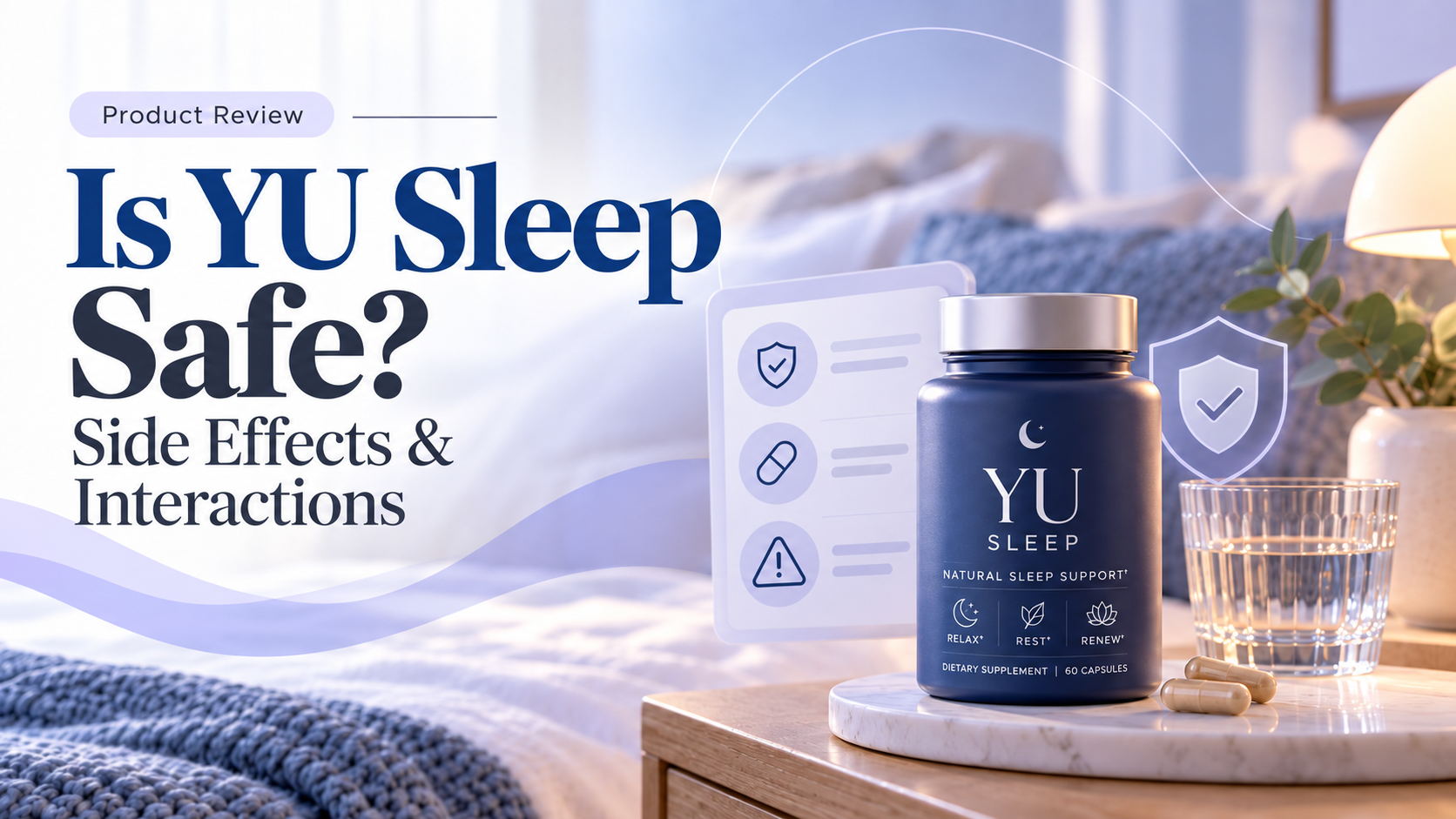
Is YU Sleep Safe? Side Effects & Interactions
Editorial note: This safety guide is based on the current YU Sleep Supplement Facts label, publicly available seller information, and independent safety information for the listed ingredients. We have not personally tested YU Sleep. Because most ingredients in the proprietary blend are not individually quantified, this article cannot provide a dose-specific safety assessment for each ingredient.
Medical disclaimer: This article is for general educational purposes only and is not a substitute for medical advice. Dietary supplements can cause side effects and interact with medications. If you take prescription or over-the-counter medication, use other supplements, have a medical condition, are pregnant or breastfeeding, or are preparing for surgery, discuss the complete formula with a qualified healthcare professional before use.
Affiliate disclosure: This article contains affiliate links. Natural Sleep Hub may earn a commission from an eligible purchase at no additional cost to you. Affiliate relationships do not change our safety analysis or editorial standards.
Is YU Sleep safe? The most accurate answer is that its label gives us enough information to identify several important safety considerations, but not enough to declare the product universally safe for every adult.
YU Sleep contains 0.9 mg of melatonin, vitamins B2 and B6, and a 637 mg proprietary blend containing red tart cherry juice concentrate, magnesium glycinate, apigenin, lemon balm extract, 5-HTP, L-theanine, and GABA.
The main limitation is that the individual amounts of those seven proprietary-blend ingredients are not disclosed. That matters when evaluating side effects, medication interactions, and whether someone may be combining overlapping ingredients from multiple supplements.
For a broader evaluation of the product, see our complete YU Sleep review. For a detailed ingredient-by-ingredient analysis, see our YU Sleep ingredients guide.
In this guide
YU Sleep Safety at a Glance
| Safety question | What we know |
|---|---|
| Melatonin amount disclosed? | Yes — 0.9 mg per serving. |
| All active ingredient doses disclosed? | No — seven ingredients share a 637 mg proprietary-blend total. |
| Could it cause drowsiness? | Possible. Melatonin can cause sleepiness, and the formula contains several relaxation-oriented ingredients. |
| Medication interactions possible? | Yes. Particular attention is warranted because the formula includes melatonin, 5-HTP, and magnesium. |
| Safe for everyone? | No dietary supplement should be assumed appropriate for every person or every medication combination. |
What the YU Sleep Label Shows
One serving is listed as 2 mL, or two full droppers.
The label provides:
- Vitamin B2 — 0.5 mg
- Vitamin B6 — 0.5 mg
- Melatonin — 0.9 mg
- A 637 mg proprietary blend containing seven additional ingredients
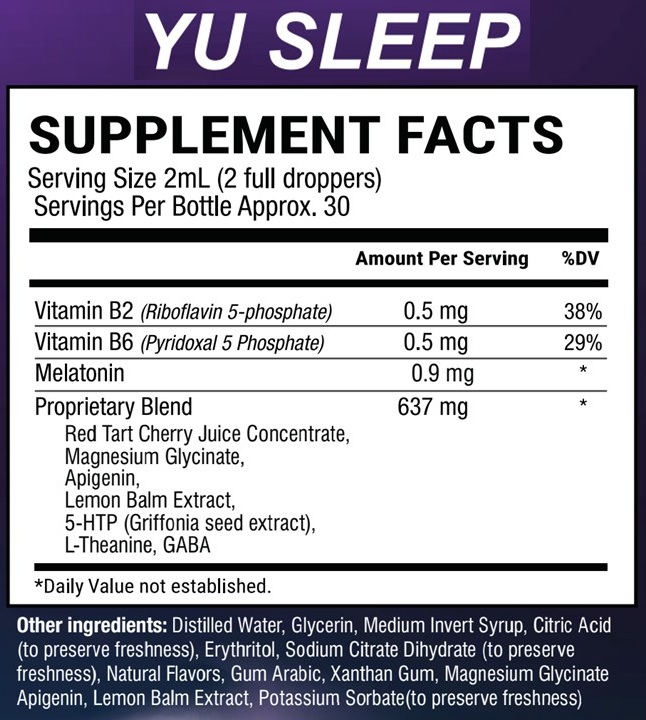
Why this matters for safety: knowing that an ingredient is present is useful, but without its individual quantity we cannot perform a precise dose-specific safety or interaction assessment.
What Side Effects Could Be Relevant?
YU Sleep does not have one simple side-effect profile because it combines multiple active ingredients.
Potential effects depend on the ingredient, the amount consumed, individual sensitivity, other supplements, medications, and health conditions.
For melatonin specifically, reported short-term side effects can include:
- Sleepiness or daytime drowsiness
- Headache
- Dizziness
- Nausea
Other ingredients may also cause gastrointestinal or other effects in some people. For example, 5-HTP has been associated with nausea, vomiting, or diarrhea, while supplemental magnesium can cause diarrhea, nausea, or abdominal cramping at sufficiently high supplemental intakes.
Because YU Sleep does not disclose the individual amounts of 5-HTP or magnesium glycinate, the label alone cannot tell us how those quantities compare with doses associated with side effects in other contexts.
Melatonin Safety in YU Sleep
YU Sleep discloses 0.9 mg of melatonin per serving.
Short-term melatonin use appears to be tolerated by many adults, but that does not mean it is free of side effects or appropriate in every situation.
The National Center for Complementary and Integrative Health notes that information about long-term melatonin safety remains limited and recommends that people taking medications discuss melatonin use with a healthcare professional.
People with epilepsy and people taking blood-thinning medications are among groups NCCIH specifically highlights for medical supervision when using melatonin.
Melatonin may also produce residual sleepiness in some people, which matters when driving, operating machinery, or performing tasks requiring full alertness.
5-HTP Is an Important Interaction Consideration
YU Sleep includes 5-HTP from Griffonia seed extract within the 637 mg proprietary blend.
5-HTP participates in pathways related to serotonin. That makes medication context especially important.
Memorial Sloan Kettering Cancer Center advises against using 5-HTP without medical supervision alongside medications that affect serotonin levels, including several classes of antidepressants.
Important medication point: If you take an SSRI, MAOI, tricyclic antidepressant, anxiety medication, or another drug that affects serotonin, do not assume YU Sleep is automatically compatible simply because it is sold as a dietary supplement.
The individual amount of 5-HTP in YU Sleep is not disclosed, so the proprietary-blend total cannot be used to calculate the 5-HTP dose.
Magnesium Can Also Interact With Medications
YU Sleep lists magnesium glycinate in its proprietary blend.
Magnesium supplements can interfere with the absorption of certain medicines. The NIH Office of Dietary Supplements identifies interactions involving some antibiotics and oral bisphosphonates, among others.
The difficulty with YU Sleep is that neither the amount of magnesium glycinate nor the amount of elemental magnesium is stated separately.
If you take medication regularly, particularly medication with known mineral interactions, the full supplement label should be reviewed rather than assuming the timing is irrelevant.
Drowsiness and Next-Day Alertness
A nighttime supplement is intended to be used around sleep, but that does not mean next-day drowsiness should be ignored.
Melatonin can cause sleepiness in some users. YU Sleep also combines several ingredients marketed around relaxation, although the individual amounts of most of those ingredients are unknown.
A cautious approach is to avoid activities requiring full alertness until you know how a nighttime supplement affects you.
Do not interpret a lack of immediate drowsiness as a reason to exceed the labeled serving.
Want to review the current YU Sleep label before deciding?
Formula information and purchase terms can change.
Visit the Official YU Sleep Website
Affiliate link. Natural Sleep Hub may earn a commission from an eligible purchase at no additional cost to you.
YU Sleep and Medication Interactions
The FDA cautions that dietary supplements can affect how medications are absorbed, metabolized, or eliminated, potentially changing how much medication reaches the body.
YU Sleep deserves extra attention in this area because it contains multiple active ingredients rather than a single compound.
Medication categories that deserve discussion with a pharmacist or clinician may include:
- Antidepressants and other serotonergic medications because of 5-HTP.
- Blood-thinning medications because melatonin can require additional medical supervision.
- Certain antibiotics because magnesium can interfere with absorption.
- Oral bisphosphonates because magnesium can interfere with absorption.
- Other medications or supplements that may cause sedation or affect alertness.
This is not an exhaustive interaction list. The correct review depends on the exact medication, dose, timing, medical history, and the complete supplement regimen.
What About YU Sleep and Alcohol?
Alcohol already affects sleep architecture, coordination, judgment, and alertness. Combining alcohol with a nighttime supplement containing melatonin and multiple relaxation-oriented ingredients adds uncertainty rather than making the effect easier to predict.
For that reason, alcohol should not be treated as an irrelevant variable when assessing how a sleep supplement affects you.
For the broader issue, see our guide to alcohol and sleep supplements.
Can You Combine YU Sleep With Other Sleep Supplements?
Combining several nighttime supplements can create ingredient overlap.
For example, another product may also contain melatonin, magnesium, L-theanine, GABA, lemon balm, 5-HTP, or another calming ingredient.
This matters particularly with YU Sleep because seven ingredient quantities are hidden inside the 637 mg proprietary blend. A person can identify the ingredients but cannot calculate the exact combined daily dose of most of them from the label.
Before stacking products, compare every active ingredient rather than looking only at product names.
See our guide to combining sleep supplements.
Pregnancy and Breastfeeding
Pregnancy and breastfeeding are situations where a general “natural supplement” assumption is not sufficient.
NCCIH notes that research on melatonin safety during pregnancy and breastfeeding is limited.
YU Sleep also contains multiple additional ingredients inside a proprietary blend, so this is not simply a question about a 0.9 mg melatonin supplement.
If pregnant, trying to become pregnant, or breastfeeding, discuss the complete formula with a qualified healthcare professional before use.
Who Should Check With a Healthcare Professional Before Using YU Sleep?
A professional review is particularly sensible if you:
- Take prescription medication regularly.
- Take antidepressants, anxiety medications, or other serotonergic drugs.
- Take blood thinners.
- Take medications known to interact with magnesium.
- Use another sleep or relaxation supplement.
- Have epilepsy or another neurological condition.
- Are pregnant or breastfeeding.
- Are preparing for surgery.
- Have persistent or worsening sleep problems.
- Experience unusual symptoms after starting a supplement.
A Practical YU Sleep Safety Checklist
| Before using YU Sleep | Why it matters |
|---|---|
| Read the current label | Formulas can change. |
| Compare other supplements | Helps identify duplicate melatonin or overlapping ingredients. |
| Review medications | 5-HTP, melatonin, and magnesium create relevant interaction questions. |
| Follow the labeled serving | More is not automatically safer or more effective. |
| Watch for adverse effects | Drowsiness, dizziness, nausea, gastrointestinal symptoms, or other unexpected reactions deserve attention. |
Frequently Asked Questions About YU Sleep Safety
Is YU Sleep safe to take every night?
The label describes nightly use, but that does not establish that long-term use is appropriate for every person. Long-term safety depends on the ingredients, individual health, other supplements, medications, and duration of use. Long-term melatonin safety data are also less complete than short-term data.
Can YU Sleep cause drowsiness?
Yes, drowsiness is possible. Melatonin itself can cause sleepiness, and YU Sleep contains several additional ingredients marketed for relaxation or nighttime use.
Can YU Sleep cause nausea?
Nausea is a reported possible effect of melatonin and can also occur with ingredients such as 5-HTP or supplemental magnesium in some circumstances.
Can I take YU Sleep with antidepressants?
This deserves professional review because YU Sleep contains 5-HTP. Some antidepressants and other medications affect serotonin pathways, creating a potential interaction concern.
Can I take YU Sleep with magnesium?
YU Sleep already contains magnesium glycinate, but the individual amount is not disclosed. Taking additional magnesium could increase total supplemental intake, so review all sources rather than assuming there is no overlap.
Can I take YU Sleep with melatonin?
YU Sleep already provides 0.9 mg of melatonin per serving. Adding another melatonin product increases the total dose and should not be treated as automatically necessary or beneficial.
Is YU Sleep safe with alcohol?
Alcohol can impair alertness and disrupt normal sleep. Combining it with a nighttime supplement containing melatonin and other relaxation-oriented ingredients adds uncertainty, so the combination should not be assumed harmless.
Does the proprietary blend make YU Sleep unsafe?
No. A proprietary blend is not evidence that a product is unsafe. The limitation is transparency: because individual amounts are not disclosed, a reader cannot independently evaluate most ingredient doses or calculate exact overlap with other supplements.
Bottom Line
YU Sleep contains several commonly used sleep- and relaxation-oriented ingredients, but “natural” does not mean universally safe.
The disclosed 0.9 mg melatonin dose provides useful information, while the 637 mg proprietary blend creates uncertainty because the individual amounts of magnesium glycinate, apigenin, lemon balm, 5-HTP, L-theanine, GABA, and tart cherry are not stated.
The most important safety considerations are medication interactions, overlapping supplements, possible drowsiness or gastrointestinal effects, and the presence of 5-HTP in people using serotonergic medications.
For someone who takes medication regularly or has a medical condition, reviewing the complete label with a pharmacist or other qualified healthcare professional is more useful than relying on a generic statement that the product is either “safe” or “unsafe.”
Check the current YU Sleep formula before deciding
Always review the latest label and purchase information.
Visit the Official YU Sleep Website
Affiliate link. Natural Sleep Hub may earn a commission from an eligible purchase at no additional cost to you.
Sources & References
- YU Sleep. Current Supplement Facts label and product materials.
-
National Center for Complementary and Integrative Health.
Melatonin: What You Need To Know
. -
U.S. Food and Drug Administration.
Mixing Medications and Dietary Supplements Can Endanger Your Health
. -
Memorial Sloan Kettering Cancer Center.
5-HTP
. -
NIH Office of Dietary Supplements.
Magnesium: Fact Sheet for Health Professionals
.