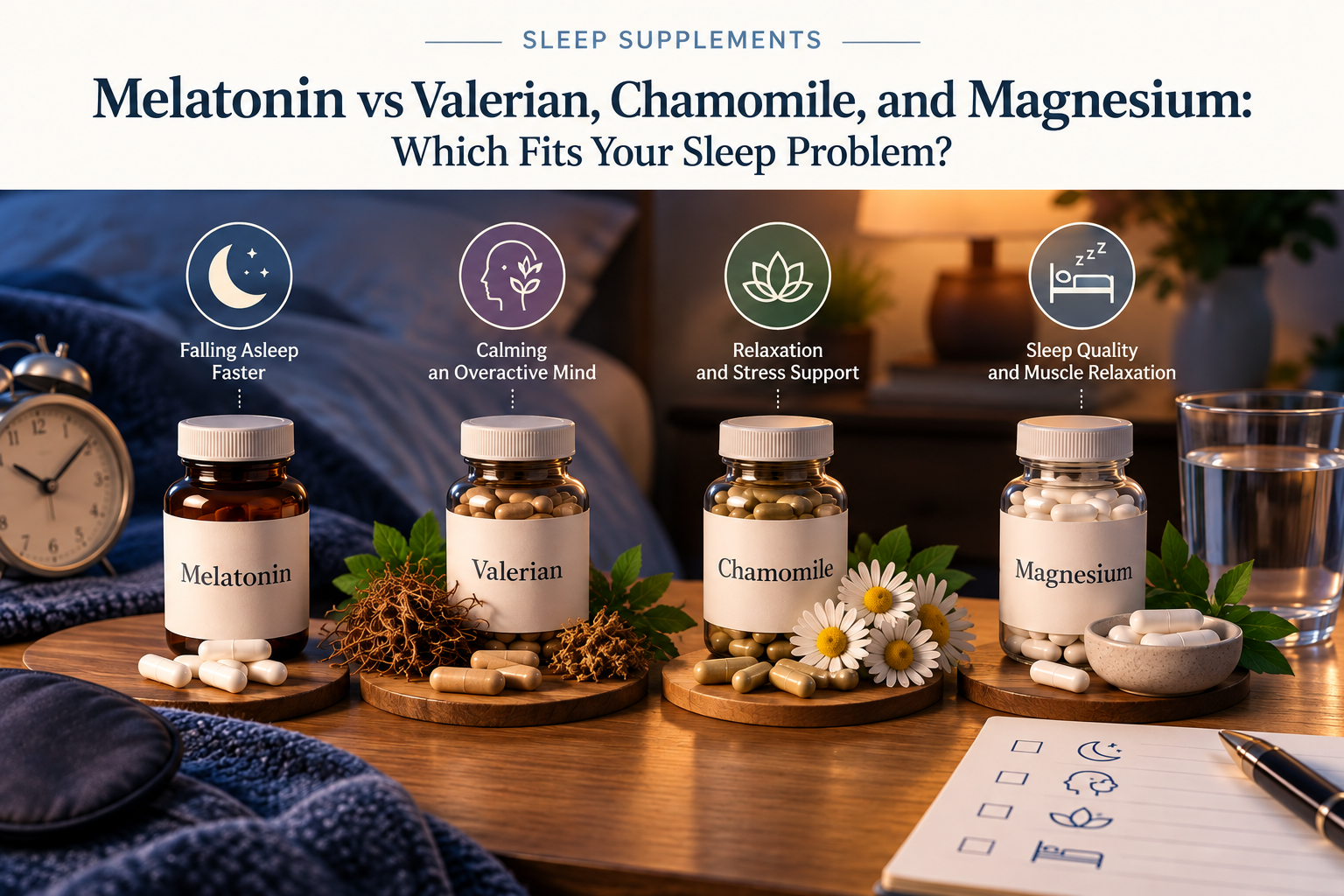
Melatonin vs Valerian, Chamomile, and Magnesium: Which Fits Your Sleep Problem?
Medical disclaimer: This article is for general educational purposes only and is not a substitute for medical advice. The usefulness and safety of sleep supplements depend on the exact ingredient, amount, formulation, sleep problem, medications, and health conditions involved. If sleep problems persist or you regularly take medication, consider reviewing supplement use with a qualified healthcare professional.
Editorial scope:
This is an educational, evidence-informed article. It does not represent personal product testing or an individualized clinical assessment.
Melatonin, valerian, chamomile, and magnesium are often grouped together as “natural sleep supplements,” but they are not interchangeable.
They differ in biological role, research quality, safety considerations, timing, and the types of sleep problems they are most often discussed for.
So instead of asking “Which sleep supplement is best?”, a more useful question is: “What kind of sleep problem am I trying to address, and which ingredient actually has evidence that relates to that problem?”
For the broader evidence picture, see our guide to what the evidence really shows about natural sleep supplements.
In this guide
Quick Comparison
| Ingredient | Main Point | Evidence Picture |
|---|---|---|
| Melatonin | Closely tied to circadian timing and biological night | More extensively studied, but benefits depend on the sleep or timing problem |
| Valerian | Herbal ingredient associated with sedation and relaxation | Mixed and inconsistent evidence |
| Chamomile | Traditionally used for relaxation | Limited evidence for treating insomnia |
| Magnesium | Essential mineral with broad physiological roles | Some potentially useful findings, but sleep evidence remains limited |
Melatonin Is Different From the Others
Melatonin is a hormone naturally involved in signaling biological night and regulating circadian timing.
That makes it fundamentally different from a mineral such as magnesium or an herb such as valerian or chamomile.
Its usefulness can depend heavily on why sleep is difficult and when it is taken.
For that reason, treating melatonin as simply a stronger or weaker sleeping pill can be misleading.
When Melatonin May Be More Relevant
Melatonin tends to make the most conceptual sense when the problem involves sleep timing rather than simply a desire for stronger sedation.
Examples of questions where timing may matter include:
- Difficulty becoming sleepy at the desired bedtime.
- A shifted sleep schedule.
- Certain circadian rhythm problems.
- Situations where biological timing is more important than general sedation.
Our sleep supplement timing and onset guide explains this distinction in more detail.
Melatonin Is Not Automatically the Best Choice for Chronic Insomnia
Chronic insomnia is more complex than simply being unable to become sleepy.
Adults with chronic insomnia may have difficulty falling asleep, staying asleep, waking too early, or developing strong cognitive and behavioral patterns that maintain the problem over time.
For chronic insomnia disorder, the 2025 VA/DoD Clinical Practice Guideline recommends CBT-I and suggests it over pharmacotherapy as first-line treatment.
See our guide to sleep supplements alongside CBT-I for that broader treatment context.
Valerian: More About Sedation Than Circadian Timing
Valerian is an herb traditionally used for sleep and relaxation.
Unlike melatonin, it is not primarily discussed as a circadian timing signal.
Its appeal is more closely related to relaxation and sedating effects, but the clinical evidence for sleep remains mixed.
Different valerian extracts, amounts, and study designs have produced inconsistent findings, so it should not be presented as a reliably effective solution for all adults with poor sleep.
Valerian May Create More Sedation-Related Concerns
Because valerian can contribute to drowsiness, its safety context is different from simply asking whether it has evidence for sleep.
Other sedating supplements, prescription medicines, over-the-counter nighttime products, and alcohol can all matter.
For interaction questions, see our sleep supplements and medication interactions guide.
Chamomile: Familiar and Traditional, but Evidence Is Limited
Chamomile is one of the most culturally familiar relaxation ingredients.
Its long history as a tea can make it feel less like an active supplement, but familiarity does not automatically translate into strong evidence for treating insomnia.
Available research does not support treating chamomile as a proven general treatment for chronic sleep problems.
Chamomile can also cause allergic reactions in susceptible individuals and may have medication-interaction considerations.
Magnesium: Essential Mineral Does Not Mean Universal Sleep Treatment
Magnesium is an essential mineral involved in many physiological processes.
That biological importance is sometimes used in marketing to imply that magnesium supplementation should improve sleep broadly.
The evidence is more limited than that claim suggests.
Studies have explored magnesium supplementation and sleep, but differences in study quality, population, magnesium form, and outcome measures make broad conclusions difficult.
Magnesium May Be More Relevant When Magnesium Status Is Part of the Question
A nutrient supplement can make more biological sense when the nutrient itself is inadequate than when it is simply added at higher amounts to an already adequate diet.
But poor sleep alone does not prove magnesium deficiency.
This is an important distinction because a product can be biologically plausible without being the right answer to the actual sleep problem.
Which Ingredient Fits Difficulty Falling Asleep?
Difficulty falling asleep can have several causes, so there is no single supplement that automatically fits the symptom.
Possible reasons include:
- A delayed sleep schedule.
- Stress or mental arousal.
- Caffeine use.
- Inconsistent sleep-wake timing.
- Chronic insomnia.
If circadian timing is the main problem, melatonin may be more relevant conceptually than chamomile or magnesium. If the problem is chronic insomnia, however, simply adding a supplement may not address what is maintaining the condition.
Which Ingredient Fits Frequent Nighttime Awakenings?
Frequent awakenings are another example of why choosing by ingredient name alone can be misleading.
Nighttime awakenings may relate to factors such as:
- Sleep apnea or breathing-related problems.
- Alcohol use.
- Pain.
- Medication effects.
- Environmental disruption.
- Chronic insomnia.
None of the four ingredients should automatically be selected simply because a person wakes during the night.
Which Ingredient Fits Stress-Related Difficulty Sleeping?
Valerian and chamomile are often marketed around relaxation, while magnesium is frequently promoted for stress and sleep.
But marketing language should not be confused with strong evidence that one of these ingredients reliably resolves stress-related insomnia.
If mental arousal or persistent worry is repeatedly interfering with sleep, behavioral approaches may be more important than continually changing supplements.
Which Ingredient Is the Safest?
There is no universal “safest” option for every adult.
Safety depends on:
- The exact ingredient.
- The amount.
- The formulation.
- Medications and other supplements.
- Kidney or liver function.
- Individual susceptibility to side effects or allergies.
Our sleep supplement safety guide covers these questions in more detail.
Can You Combine Melatonin, Valerian, Chamomile, or Magnesium?
Commercial sleep products often combine several of these ingredients, but the existence of a combination product does not prove that the mixture is necessary, superior, or appropriate for every adult.
Combining products can create duplicate ingredients, overlapping sedation, higher total intake, and more complicated medication interactions.
See our guide to combining sleep supplements before assuming that several ingredients are better than one.
Amount Matters as Much as Ingredient Name
Two products labeled “melatonin” or “magnesium” can provide very different amounts.
Likewise, valerian products can use different extracts and chamomile products can differ substantially in form and concentration.
This is why ingredient names alone are not enough to compare products.
Our sleep supplement dosage guide explains why more is not automatically better.
How to Choose Between Them More Rationally
Instead of choosing by popularity, consider this sequence:
- Identify the actual sleep problem.
- Check whether the ingredient has evidence relevant to that problem.
- Look at the exact amount and formulation.
- Review medication and supplement interactions.
- Avoid assuming that a longer ingredient list means a better product.
- Reassess if the sleep problem persists despite repeated use.
If you are comparing commercial products, use our adult sleep supplement buyer’s checklist to evaluate labels, evidence, testing claims, cost, and purchase terms.
When a Supplement Comparison May Be the Wrong Question
If sleep problems are persistent, severe, or accompanied by symptoms such as loud snoring, breathing pauses, significant daytime sleepiness, restless legs, persistent pain, or major mood changes, choosing between melatonin and magnesium may not address the real issue.
Likewise, repeatedly switching supplements can delay evaluation of chronic insomnia or another sleep disorder.
Our guide to better sleep without supplements covers habits, CBT-I, and situations where professional evaluation may be more useful.
Frequently Asked Questions
Is Melatonin Better Than Valerian for Sleep?
Not universally. Melatonin has a clearer role in circadian timing, while valerian is more often discussed for relaxation and sedation. The evidence for valerian is mixed, and the usefulness of melatonin depends on the sleep problem and timing.
Is Magnesium Better Than Melatonin?
They address different biological questions. Melatonin is involved in circadian timing, while magnesium is an essential mineral. Neither should be called universally better without knowing the reason for poor sleep and the relevant health context.
Is Chamomile Stronger Than Valerian?
“Stronger” is not a useful scientific comparison. Valerian and chamomile are different herbal ingredients, and neither has evidence strong enough to justify a simple potency ranking for insomnia.
Which Is Best for Falling Asleep Faster?
There is no single best ingredient for everyone. If the issue is related to delayed circadian timing, melatonin may be more relevant than a general relaxation ingredient. If the problem is chronic insomnia, behavioral treatment and evaluation of the underlying cause may be more important than choosing another supplement.
Can You Take Melatonin and Magnesium Together?
They appear together in some commercial products, but that does not mean every combination or amount is necessary or appropriate. Check the full label, medication list, total intake, and whether both ingredients are actually relevant to the sleep problem.
Which Natural Sleep Supplement Has the Strongest Evidence?
Melatonin is among the most extensively studied sleep-related supplements, but that does not make it the best choice for every adult or every type of sleep problem. Evidence should be matched to the specific condition rather than ranked by ingredient popularity.
Bottom Line
Melatonin, valerian, chamomile, and magnesium should not be treated as four interchangeable versions of the same sleep supplement.
Melatonin is most distinct because of its role in circadian timing. Valerian is more closely associated with sedation but has mixed evidence. Chamomile has extensive traditional use but limited evidence for treating insomnia. Magnesium is biologically important, yet current sleep evidence does not support treating it as a universal sleep solution.
The better approach is to identify the sleep problem first, then ask whether the evidence, formulation, amount, timing, safety profile, and medication context actually fit that problem.
References
-
National Center for Complementary and Integrative Health.
Melatonin: What You Need To Know. -
National Center for Complementary and Integrative Health.
Valerian. -
National Center for Complementary and Integrative Health.
Chamomile. -
NIH Office of Dietary Supplements.
Magnesium: Fact Sheet for Health Professionals. -
PubMed.
Systematic Review of Magnesium Supplementation and Sleep. -
U.S. Department of Veterans Affairs and Department of Defense.
VA/DoD Clinical Practice Guideline for the Management of Chronic Insomnia Disorder and Obstructive Sleep Apnea (2025). -
American Academy of Sleep Medicine.
Behavioral and Psychological Treatments for Chronic Insomnia Disorder in Adults.